Tuesday, January 30, 2007

Words of Wisdom from An Agent Provocateur

Been chatting with gabe chouinard, infamous genre bastard and general crank*, and he offered this gem:

10:26 PM gabe: i think of it this way. you can't go lengths to disguise your local color, because it's who you are as a writer. but aim for an international market, and leave it to that market to educate themselves about your particular place.
10:27 PM like, Pamuk. Love him, obviously. But he writes very Turkish novels. Does that detract from my liking them, because i don't "get" that Turkish infusion? No, it means I have to learn as i read.
me: Mmm....
gabe: it's up to the reader to take away what he/she can, and up to the writer to remain honest. (gabe's koan for the night.)

Something to muse about when one is writing for an uncertain audience, yes?

*And yes, check out the links. They're good reading.

Wednesday, January 24, 2007

Darkness Lost, Darkness Found

I love anthologies.

Moreover, I love short story anthologies that are definitive, like Harlan Ellison's Dangerous Visions, Peter Straub's Conjunctions 39, Alberto Manguel's Blackwater, James Patrick Kelley and John Kessel's Feeling Very Strange, Delia Sherman and Theodora Goss's upcoming Interfictions, Jeff and Ann Vandermeer's upcoming The New Weird (I know, the last two are not out yet, give me a break), or Robert Silverberg's Legends. (yes, this is disputable but hey, it looks nice on my shelf).

So imagine my surprise when I found (and bought) at a second-hand bookstore a trade paperback copy of The Dark Descent, the seminal horror anthology edited by David Hartwell.

Alas, my only regret is that I once found a hardbound copy of Foundations of Fear-- the companion anthology to to the above-- but didn't pick it up. I was young then... and foolish.

*sigh*

I don't suppose anyone's seen a copy of this I can buy?

Monday, January 22, 2007

The Reel Life: Of Monsters and Men

As the year goes, it looks like movies I've watched in 2007 is starting off well.

The first one I quite enjoyed was something I heard online that was suposedly good: The Host (Gwoemul, 2006). The fact that it was a Korean movie was an added bonus since [identity-protected's] sister is currently enthralled by Korean movies; I asked for and got a copy last year.

My assessment? It's very good, as good as the reviews say.

Director Bong Joon-ho's movie is, at its core, a monster movie. A chemical spillage from an American military base in South Korea creates a monster that terrorizes the river Han. However, this movie is more than about a CGI-monster (and a well-crafted one, too, this ain't no rubber-suit lizard or Boa vs Python) as it details a dysfunctional family's efforts to rescue one of their own from the slimy beast's clutches.

Moreover, the movie has a humorous bite to it, ranging from the distraught father's (whose daughter it was that was snatched) Kafkaesque's experience at the hands of the American and South Korean military to the same family's expression of pain inside an auditorium full of grief-stricken survivors.

However, it's the human drama of the long-suffering grandfather, the slow-witted yet loyal first son, the angry second son, the talented yet shy daughter, and the granddaughter's fragile strength to survive the trials that makes this a must-watch movie.

In other words, this is a monster movie wherein the humans aren't just snacks, they're real people too.

On the other hand, Alfonse Cuaron's Children of Men, based on the novel by PD James, isn't a movie that will survive close scrutiny, given its premise of a world on the brink of collapse. At the movie's start, the human race is trying to deal with its own infertility, with no baby being born in the last 18 years.

Centering on a totalitarian Britain (reminiscent of V for Vendetta) that has targeted immigrants as their enemy, Clive Owen plays a jaded, former activist-turned-bureaucrat who must deal with the fact that a young black girl is pregnant even as he tries to smuggle her out of the country.

Cuaron diverts the watcher's attention from possible questions about the said situation (i.e. why are people infertile?) by combining dark, grimy shots of London and its towns, almost-ridiculous yet quite effective chase scenes (see the protagonists' escape from the rebels by pushing their stalled car downhill), and a bloody showdown at a refugee camp.

And again, it is the characters that make a difference in this movie with Owen playing a man out of touch dumped smack-dab in the middle of the confusion thanks to his ex-wife, (played by Julianne Moore) who also happens to be the leader of the rebel group, The Fishes.

Despite their short film-time together, the scenes between the two are quite poignant as they ricochet between sentiment (their dead son Dylan), argument (who was at fault for their split) and pragmatism (money in exchange for papers).

Likewise, Cuaron has a soft touch, especially the surreal moment when the baby makes her appearance in a battlefield and her cries silence the guns between goverment soldiers and rebels.

Watch this movie but be warned: this is a heavy popcorn movie where you have to leave the popcorn at the door.

(In real life, I also watched some movies as exciting as a burning house. Much-looked for Happy Feet had really cute baby penguins and chicano penguins; however, the enviromental ending was a bit heavy-handed and abrupt for my taste. Likewise, Night at the Museum didn't really grab me as I'd seen it all already in Jumanji. Sorry, Rexy.)

Wednesday, January 17, 2007

A Dialogue on "The Middle Prince", Writing and Expectations

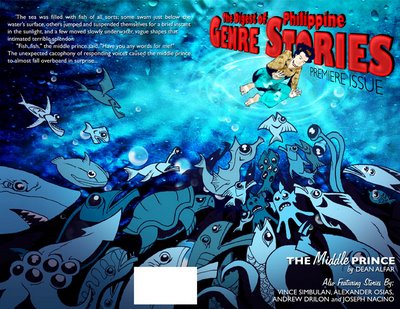
I had an interesting discussion with a fellow-writer/reader friend via SMS text (and given the length of our statements, that's hard to do using cell phones; I bow to my friend's locquaciousness and thumb dexterity) last week on dean's story, "The Middle Prince," in Philippine Genre Stories. This later turned into a dialogue on what should be expected from a writer.

Personally, I believe that as a writer-- like anything we do in life-- one must push the envelope in order to better one's self. However, something the friend said made me stop short and wonder: how much should one push? Moreover, are we also expected to fail?

Slight editing of the text messages to make it flow like a regular conversation. Hope I got this right. Also, to understand the conversation better, one has to read the said story-- which would be my plug for everyone to go buy the first issue of Philippine Genre Stories. *winkwink*

Me: Not sure bout your deconstruct comment [in a previous email] but isn’t storytelling separate from the need to attach the cultural aspect of the method, i.e. the use of fairy tales? You did say Dean had different intention in writing it?

friend: Well, from the story’s perspective, the ‘rules’ of fairy tales are important, what the prince is trying to get away from. Missing that one detail makes his final statement a bit less powerful, a bit more disingenuous. Plus ‘following the rule’ would’ve opened up some missed narrative opportunities to my mind.

friend: Dean was doing something really brave. I think it’s a writer’s obligation to convince the reader ‘this is how it went down’, but by reworking a fairy tale the way he did, talking about the ‘rules’, he opens the story up to ‘but it should’ve gone this way’. The subversion of such ‘rules’ is arguably the point, but the fact that it was a ‘small, side detail’ makes it all the more important that it be recognized.

friend: By the ‘cultural aspect’ I meant the basic commonsensical nature of fairy tales, sending one brother out at a time, for instance, while having a definitive narrative purpose, also says something about how fairy tales understand ‘how the world works’ to my mind.

friend: Did I say something about Dean’s ‘intentions’? God that was pretentious of me.

Me: My question is how much do we expect from writers? Are we storytellers, fabulists or deconstructionists? My take is that yes it was a slight subversion of fairy tale tropes. But it was also a lesson on expectations or even destiny. How much are we expected to push the envelope?

friend: Definitely. Dean’s story was the most moral of the issue 1 stories, had the most important things to say about the human condition. However, choosing the method creates its inherent set of expectations that ultimately affect the power of your message. To my mind, Dean’s lessons would have been more meaningful had the story paid attention to that detail.

friend: So to answer what to expect from writers? Basically, as much as possible: for the writer to be the best possible guide for his ideas and story. (Incidentally, I myself consciously try to subvert that fact, putting the burden of understanding on the reader more than may be typical.) As a reader, you find what works for you, try to understand what doesn’t. That’s how I approach my criticism. Maybe I just demand more from my reading than other people.

friend: Not to say that a writer should ‘spoon-feed’ the reader, something I detest, but being the ‘best guide’ doesn’t necessarily mean ‘laying it all down’.

Me: Am very torn bout this question because from one end I get what you mean bout pushing the envelope for the writer. From the other end, am intimidated because so very high stakes are set.

friend: Well, that’s one of the challenges of being a writer.

Me: So you’re saying Dean’s method of transmission of the story was at fault here?

friend: The ‘method of transmission’ is a whole other set of comments entirely. In the sense of ‘middle prince’, all that talk of expectations for a writer comes into the details he chose to put in and what not to put in. In a sense, does Dean assure us he knows what he’s saying about fairy tales? Not saying he doesn’t but missing that details begs the question in my mind, given what he’s ostensibly trying to say.

Me: Am still undecided because I still think the story worked for me on one level. But I admit that a story has many levels and that I think is your point bout where it fails.

friend: Actually, thinking about the so-called ‘flaw’ that’s central to my argument, here’s a way to effectively tear it down: can you think of a fairy tale where all 3 brothers set out separately but at the same time? I can’t remember, but I suspect ‘Adarna’ may have gone that way.

friend: You might find this weird, but now I’m talking apart my own argument: fairy tales do not have a set of ‘rules’ for the actual narrative. The ‘rules of play’ for the fairy tale game are strictly moral rather than structural; ergo, there’s no such flaw in Dean’s re-working of the fairy tale.

Me: What is a fairy tale made of? What is it made for? When the first folk tellers came up with the story, did they come up with ‘structure’ or ‘moral’? Too many questions.

friend: It’s an interesting set of questions because it tells what exactly is at the bottom of human consciousness. The form or the function? Was the 1st story, the archetype of all such tales, a retelling of specific sequence of events, the meaning coming later and thus dependent on structure, or did the meaning come 1st, making each element more flexibly poised? Thinking about it that way, however, I find myself more ‘forgiving’ of what I first saw as flaws.

Me: Didn’t most fairy tales have brother princes leave separate? Including Adarna?

friend: That’s what I thought, but am wondering. Maybe there’s a precedent for what Dean did with his princes.

Me: Another thought. Since we also don’t know what dean’s exact thoughts on the matter, he may have known bout the structure of fairy tales but decided to forgo it altogether. You know what they say in writing, know the rules then break them.

friend: That would seem disingenuous in a way because if the structure is important, then the middle prince should have been trapped into that as well. The defense I’ve just now formed is this: the elements of a fairy tale are symbols whose meanings are fixed regardless of the encompassing narrative. Ergo, it doesn’t matter whether the princes leave together, only what each prince represents. That works if the things I posited as part of the subtext of the fairy tales in my first argument don’t matter.

Me: Also wasn’t it a metafictional fairy tale? Because the middle prince knew what was expected of him and was resigned to it to the point of subverting the whole storyline?

friend: Yeah, it was ‘metafictional’, which is why it’s also important to my mind, to figure out whether structure is inherent in part of the elemental nature of fairy tales.

Some interesting food for thought, especially as I write my stories. Personally I liked the story and thought it was effective even though it didn't follow the 'basic rules' of fairy tales. But I do admit I'm not much a critical reader (given how I missed the fairy tale angle in the first place).

Does it even matter in the ultimate course of the reading/writing of the story? I thought not: if it did the job pretty well, after all.

But what is the story's "job"? What I assumed of it or how my friend understood it?

What do you think?

Edited to add: Here's dean's response to the matter. Likewise, here is sean's review of the digest.

Tuesday, January 16, 2007

A Wince-worthy Moment

Yeesh.

I was trying to finish a story for fantasist Jeff Vandermeer's upcoming pirate anthology, believing the deadline was this January 15. Trust me when I say I was really rushing to do the job.

However, a check at his website revealed that instead of January 15, the actual deadline for submissions was February 28. Aside from feeling idiotic, I was left wondering: where did I get the idea that the deadline was this middle of January?

Anyway, back to the grind...

Friday, January 12, 2007

A Night in Big Sky Mind

(a protrait of [identity-protected] taken last week courtesy of the Big Bash)

...And so they talked throughout the night under the eyes of the grotesquerie on the walls. Rather, he talked; she listened, sitting on the ancient moldy sofa with a constant hand bearing a cigarette.

He said the reason he could never speak about their love was because words had power, and that words limited what-could-be into what-is. But he also said their love was bigger than any word that he could find. That was why, he said, he wrote stories: because he knew such words would serve as poor analogues of the vastness of the heart.

And since words have power, at the moment of the last word of his declaration, he felt himself dissolve and blow away in the dust...

Monday, January 08, 2007

Curious Cat Question

Just wanted to ask: at your lowest, particularly saddest moment, what song would you like playing in the background?

You know, that point in time when you're sitting at the bar counter alone with a half-empty bottle of beer clutched in one hand as you muse about the vagaries of life?

Am thinking something like either Radiohead's "High and Dry" or REM's "Everybody Hurts" (both of which had music videos featuring random people singing at a bar counter-- go figure).

Well?

A Post from the Storm Lands

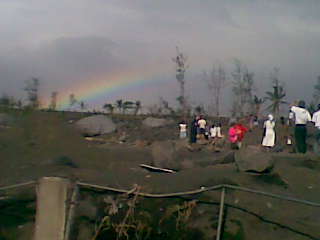
Got these pictures from [identity-protected] when she visited Albay just after Christmas, Bicol being recently hit by a couple of supertyphoons a month or two ago.

When I visited Naga City on New Year's Day, the effects were still visible here and there, including a couple of steel electric towers bent in two. (Geez, didn't know those things could bend like that.) The thing is, Naga City wasn't hit as badly as the province of Albay so they were a bit lucky in that part. Still, it'll take a longer time for the people of Albay to recover from the past year.

(Apologies first for the quality of the shots. These were taken by [identity-protected]'s Nokia cellphone.)

Anyway, here's one shot of the famed Cagsawa ruins, an old church buried to its roof but leaving the steeple tower exposed. Supposedly the soil has gotten a bit higher and burying the church even more, Bicol folk say. (Yes, that's the obscured Mayon volcano in the background.)


And a lot of houses in Albay province were buried under landslides due to the rains. However, [identity-protected] managed to convey a little of the hope as people continue to dig through the wreckage of their lives.


Here's hoping that the new year will be like that: a little of hope always shining through.