Showing posts with label books. Show all posts

Saturday, May 03, 2014

Ex Libris: Lucius Shepard's The Beast of the Heartland and Other Stories

I wonder if other readers feel the way I do, that I've come to a certain milestone when my favorite writers-- those whose books had changed my reading life-- pass on. I suppose I'm just feeling my age especially after I heard of Lucius Shepard's death this year.

I read his story collection The Jaguar Hunter first: strangely enough, I had no idea what to expect based on the recommendations I read-- except that he was a great writer. And maybe that was a good thing because when I did start reading him, I realized that he wasn't just writing speculative fiction, it was great Fiction that had the punch of several quick open-palm slams to the face, chest, and groin that would send you reeling to your knees but with tears of joy in your eyes.

His prose was a wonderful combination of hard-hitting, hardbitten, almost-practical realism with flashes of literary turn of phrases (what would be termed magical realism). His stories were mostly genre, sometimes with twists that would leave you gasping for breath, but otherwise were genre-less for the oh-so human characterizations of his protagonists.

So yes, I think that regardless of what I say or do from this point onward, I think I will always remain a fanboy of Shepard's work.

That's why in commemoration of the man, I dug out my still-to-be-read collection of his works and started reading his other story collection, The Beast of the Heartland and Other Stories. (On a side note, it took me a long while scouring the bargain bins for a copy of this collection. I once missed out buying the UK edition of this book, Barnacle Bill the Spacer and Other Stories, at the local Fully-Booked and I've always regretted it because it matches the third collection I have of his, The Ends of the Earth. But I digress.)

Regardless of how I felt about each story in this collection, every beginning of his stories was a wonder. That is, I would always think a few words into the story, "I wonder what this will be about." And why not, when you have such wonderful opening lines to begin with. To wit, from "Barnacle Bill the Spacer":
"The way things happen, not the great movements of time but the ordinary things that make us what we are, the savage accidents of our births, the simple lusts that because of whimsy or a challenge to one's pride become transformed into complex tragedies of love, the heartless operations of change, the wild sweetness of other souls that intersect the orbits of our lives, travel along the same course for a while, then angle off into oblivion, leaving no formal shape for us to consider, no easily comprehensible pattern from which we may derive enlightenment..."
Or, from "A Little Night Music":
"'Dead men can't play jazz.'"
Fascinating, no? Makes you want to read more.

Each story in the collection varies in genre: drugged-surreal religious horror in "A Little Night Music"; a post-apocalyptic tale "Human History" that seems to be the ancestor of Cormac McCarthy's The Road; the very noir "Sports in America" that calls up Raymond Chandler but reminds me of Patricia Highsmith as well; and a story about a boxer on the decline that seems to be ripped out of the pages of GQ or Esquire, "The Beast of the Heartland."

So yeah, I'm in like Flynn, regardless of how each story ends. Thus, rather than letting me blather on and on how wonderful this collection is, it's better if I'll sign off. Heaven knows if you don't think that I think the man was a great writer, then nothing I write will convince you.

Get thee to a bookstore and buy it! (Four paws out of four.)

Friday, February 21, 2014

Ex Libris: Warren Ellis' Gun Machine


In the City of Fiction, there is a street that runs two-way. One heads toward the suburb of Comics while the other goes to the bohemian district of the Novel. On this street, there are writers who live in the suburbs: these comic book writers have made a name for themselves in their field like Mark Millar, Matt Fraction, Gail Simone, Garth Ennis, Geoff Johns, and Grant Morrison.

But there are also a few comic book writers who commute and are currently working in the Novel district.* Most notable among those are Neil Gaiman, Mike Carey, Peter David, and Alan Moore dipping his pen onto the pages of the fray. And then, of course, there's Warren Ellis.

I enjoyed Ellis' first novel, Crooked Little Vein, and though he topped that book to the brim with fascinating ideas like the way he did with his comic books, I thought the shift from comic books to books had lessened the sharpness of his writing. His protagonist Michael McGill--though while interesting-- didn't have the weight of his other characters like Spider Jerusalem, Elijah Snow or Jenny Sparks. It was all firework showers but no big bang of the gonzo reporting in the future of Transmetropolitan, the "archaeologists of the impossible" in Planetary, or the worldwide spanning rescue organization in the Global Frequency.

Gun Machine fortunately shows Ellis settling into his role as a novelist by limiting himself to a handful of particular concepts. Here, NYPD detective John Tallow finds a mystery when his partner is killed by a wacko with a gun in a dilapidated apartment. Though Tallow takes down the shooter, a stray shot reveals the contents of the unit next door: a veritable shrine of guns filling the apartment from floor to ceiling, all of the weapons linked to a decade's worth of unsolved murders in the city.

Shifting perspective, Ellis reveals these killings were done by a prolific serial killer named The Hunter who has let himself be hired by a group of people to take down anyone that stands in their path. The Hunter is another interesting creation by Ellis: the killer perceives Manhattan through two different times, the current age and a pre-New York wilderness. Moreover, The Hunter believes that if he somehow completes his shrine, he would be able to supernaturally return the city back to its Eden-like state.  

The good news is that with Gun Machine, Ellis has created a fascinating, sometimes amusing, detective thriller, a "cat-and-mouse" chase as Tallow tries to find The Hunter through the Ellis-weird streets of New York City. He even manages to introduce an endearingly weird pair of CSI characters to act as the story's score card. But unlike Crooked Little Vein which switched back-and-forth between the Weird Americana (reminiscent of Planetary) and snappy political commentary (natch, Transmetropolitan) so fast you would have gotten whiplash, Ellis keeps the plot together this time and brings it all the way to a nice, proper end.

The bad news is that, like Crooked Little Vein, this story still felt slight such that I didn't feel totally involved in the story. Essentially, I get the feeling that Ellis' novel-writing skills isn't all there yet. Maybe that's the problem with comic book writers-turned-novelists. In comic books, there's really no chance for the writer's voice to be heard. And that's okay-- because for comic books, it's the artist's skill that recreates the narrative in the reader's mind.

However, in novels, it's the writer's voice that delivers the narrative. Think of a number of characters' voices in comic books-- say, Jerusalem Spider of Transmetropolitan or Yorick Brown of Y the Last Man. These aren't the voices of the writers but of the creations themselves. In novels, the writer's voice or the voice of the narrative is distinct from those of the characters.

But despite the two novel-misses so far, Ellis still remains hands-down one of the best idea man/writer in the business regardless of the medium (i.e. comics or books). You can actually see how much he's improved his skills from one book to the next and that's why I'm still game to try out his next book.

Your mileage may vary. (Two paws out of four.)


*Yes, I know there are novelists who have tried their skill writing comic books, like Joe Hill, Clive Barker, and Chris Roberson. Likewise, most of these writers still go back and forth this street writing comic books and/or novels. Bear with me on this metaphor.

Sunday, January 19, 2014

Ex Libris: Felix Gilman's The Half-Made World

When I traveled to the US for the first time several years ago, I had the strangest realization. Moving from one state to another, I felt that US as a country-- for all of its traditions and age-- was still a young one.

I came to this realization because my first travels abroad were to Asia and Europe. In those countries, you could feel the history of the land in every step you take where the next corner held a castle or temple. (Well, except for Singapore, which felt relatively "new" but you could sense that its traditions were more than likely borrowed from its neighboring countries.) In the US, you could say their mythology flourished in the early days of its industrialization, before science and technology cleared away all ambiguity and mystery.

I make this point because if there's one subgenre I'm fascinated, it's the fantastical mirror of American history of the Old West, which some have tagged as "Weird West". (Digression: I say "mirror" here in the same sense that epic fantasy supposedly mirrors-- however distorted-- the European Medieval period with its kings and wars and dragons. It may be funny to say this but I actually gained a sense of history of other countries because of the fantasy genre, which mostly focuses on the European kind.)

Two examples of the Weird West subgenre that easily come to mind is Mark Sumner's Devil's Tower (which had magic coming into the world during the American Civil War) and Stephen King's Dark Tower series (which mashes up the Old West as a Byronic fantasy land with six-guns). Unfortunately, this American mythology rewritten into a type of Old West fantasy comes in few and far in between. Fortunately, now there's Felix Gilman's The Half-Made World, which makes a good try in envisioning a steampunkish/Weird West.

In The Half-Made World, there are two factions vying for the making of the newly-shaped Western lands. On one hand, there is the Line, a dark retelling of the industrialized American North circa the Civil War under the influence of dark gods of order in the shape of demonic train engines who lay tracks across the new territories. Though these gods offer their followers a science that drives the smoke-belching engines of the new age, the price of the new order leaves their worshipers nearly mad.

On the other hand, there are the Agents of the Gun, a cult-like loose group of outlaws and murderers (both men and women) who bear supernatural spirits in their totem-like guns. These guns bequeath their Agents powers, from strength and speed, fast healing and near-invulnerability (though they can be killed). These Agents sow chaos across the land in the cause of their singular independence from any authority-- and sometimes even from their own guns.    

As the story opens, a third faction has just been crushed by the Line and the Gun, a group of towns that called themselves the Red Republic and had gloriously refused to align themselves to either factions. In the dying days of the Republic, its famous general had been driven mad by the bombs of the Line just as he discovered a secret that could give either factions a power against each other-- or destroy both of them completely.

Into this story comes Doctor Liv Alverhuysen, a psychologist escaping the death of her husband and her sheltered life in the civilized cities of the East by treating the maddened victims of the war. Crossing her path is John Creedmore, an Agent sent to find the general, even as the forces of the Line go on the march.  

Like other works that have preceded his, Gilman creates a creative analogue of the American Old West mythology that envisions the clash of the anarchy and free spirit of the Wild West against the Age of Industrialization that had descended on the US. Moreover, Gilman plays no favorites among the two factions: Liv has equal chances of being killed by either the lone gunman Creedmore or by the low-level Line officer Lowry and the army he leads.

However, even the characters carry the externalized conflict of the Gun and the Line (i.e. order versus chaos) within them as Gilmore avoids the easy generalizations. Creedmore may be an old Agent, a feat worthy of the description for the simple reason that despite their powers, they are still too few against their enemies and they can still die. But Creedmore is disillusioned by the freedom given him by his demonic overlords and wants only to be free of their control. On the other hand, Lowry is a cog in a giant machine. But like Walter Mitty living in an Orwellian 1984-like society, he rationalizes away his drive for glory by going after Creedmore and Liv as simply "following orders".

But The Half-Made World isn't just about conceptualization and world-building as Gilman deftly writes a good story, juggling the main narrative with enough flashback scenes to flesh out the characters. He then brings up the level of drama to compensate for the slight drag in the chase scene partway through the book, giving us a look at how Creedmore and Lowry would act separate from their gods. Sometimes it seems like Gilman is rambling far too slow with his story but he ties the narrative back together again.

All in all, Gilman scores high points with this book, from the main idea to the story. Though he fills in the external background of Eastern cities in rough sketches, he more than makes it up by creating a stark picture of the new Western lands in the process of being born despite the ravages of war, easy violence, slavery, and ignorance. Likewise, he easily fields questions about the price of free will and the blind worship of gods (whether supernatural, scientific or philosophical) via the characters' expressions and actions.

A good read. (Three paws out of four.)   

UPDATE: Here's a more recent review by Kirkus of Weird West stories out in the wilds.

Tuesday, January 15, 2013

Ex Libris: David Wong's John Dies at the End


What is horror? Is it the vision of a new monster? Is it something sneaking up behind you? Or is it blood and guts strewn all over the floor? Obviously, this question has been answered quite a few times already but I get the feeling that David Wong, author of John Dies at the End and pseudonym for Cracked.com's editor-in-chief Jason Pargin, is trying to answer this question for today's Internet generation.

Why the Internet generation? Not surprisingly, it was the Internet that made this book popular. John Dies at the End first started as a continuing story that Pargin wrote online, which gained a multitude of fans. It was later picked up by small publisher Permuted Press before going mainstream as a hardcover (and with additional material) via Thomas Dunne and even an upcoming movie.

Given its online audience, the story is shaped by its online expectations: episodic chapters that go for the jugular with short, sharp, shocks of horror laced with scathing slacker humor. This horror story mirrors the Internet cradle it was born in, i.e. our real world unaware of another world that's just a thin slice of reality away. The narrative itself also shows its Internet influence with its meta-fictional approach, the protagonist (also named David Wong) talking directly first to the reader and then to a skeptical reporter trying to determine whether he's just being fed a line or a revelation in the ultimate of headcase conspiracies.

To sum up the story, the protagonists David and his friend John discover a new type of drug, dubbed "soy sauce", that turns the brain into a fuel-injected engine and enables its users to create home-made bombs, slow down time, and solve mathematical equations on the fly. Unfortunately, the drug-- which is nearly alive-- also allows the users to perceive the things we don't allow see: the monsters that inhabit the interstices of our reality. Likewise, the drug eventually turns its users into a dimensional portal for these monsters from their homeworld and into our own, killing the users (or subsuming them) in the process. Lastly, the drug is so powerful that once you partake of it, the effects never really go away.  

Despite its episodic nature, David Wong (the author) does try to fill in the mythology of his tale that shows influences that are either Lovecraftian in nature or plain and simple paranoidal nutjobbery. These range from the shadowy beings that haunt the characters to the omnipotent horror (with a mentality and sense of humor of a 5-year old) named Korrok waiting in the next dimension to take over ours.

Likewise, I also have to remark that though David and John are the primary protagonists of the tale, it felt like John was more of an internet cypher for David, a foil who gets him into trouble rather than a solid character of his own (the Internet personified, hmmm?).

So, going back to our original question, we ask: does today's horror work? Only if you grew up with a sense of humor more attuned to lols from 9Gag or 4chan. In this case, David Wong's (the author) sense of horror is similar to Internet humor in the same way that Internet humor is like a quick upper cut to the chin before anyone notices. Now this isn't a bad thing altogether but it does get to be droll at times it happens over and over again. At the most, John Dies at the End promises to be an entertaining read, something to read before the movie comes out. (Rating: 3 paws out of 4.)

Saturday, January 05, 2013

A Wrap-up of What I Read in 2012


Remember what I said about 2011 being a terrible year because my reading rate had gone down? Well, this past year was even worse. For 2012, I didn't even read half of the number of books I read last year.

Count 'em, I only read 18 books this year.

18 BOOKS.

18 BOOKS.

What the hell happened last year?

Okay, there was January when I lost my job when Megaupload shut down. Fortunately, I managed to get a job a week later for an online gambling company. But due to a heavy/complicated job load, work politics, and moving into a new place on my own, I found I had less time to relax-- including time to read.

So yeah, I read only 18 books-- and 2 of them I dropped a third of the way because I wasn't really getting into them. This is pretty good, given that I dropped 5 books from my 2011 reading list.

(Let me clarify this one: as I've gotten older, my patience for reading books I don't like has gotten shorter. But I give them a lot of chances, figuring that I'm not in the right mood and I'll just put it aside for the moment for another-- easier-to-read-- book. And there are other books I really like despite some obvious flaws and I continue to hold on to 'em and reading them off-and-on for years. So yeah, if I give up on a book, then that book's given up for lost. But I digress.)

So what did I read the past year? It's a mixture of genre (fantasy, SF, horror) and literary reading as usual. Some of these are a mix of both or even new subgenres, like Western-horror. But all of these still fall into the category of speculative fiction, i.e. the element of strangeness is a prominent factor in the story.

The list is as follows:
  1. Bestial, William D. Carl 
  2. Blood Bound, P.C. Hodgell 
  3. Geist, Philippa Ballantine* 
  4. The Crippled God, Steven Erikson 
  5. Not Flesh nor Feathers, Cherie Priest 
  6. The Demon and the City, Liz Williams 
  7. The Thorn and the Blossom, Theodora Goss 
  8. Ready Player One, Ernest Cline 
  9. Blackout, Mira Grant 
  10. The Black Lung Captain, Chris Wooding 
  11. MM9, Hiroshi Yamamoto 
  12. The Fallen Blade, Jon Courtenay Grimwood 
  13. Our Tragic Universe, Scarlett Thomas* 
  14. Dust of the Damned, Peter Brandvold 
  15. This Dark Earth, John Hornor Jacobs 
  16. Zone One, Colson Whitehead
  17. Double Dead, Chuck Wendig
  18. Hart and Boot, Tim Pratt
Looking at this list, I suppose this is what happens when Life happens. Between reading a book and earning a living, we all know the choice we have to make, right? And it's not like I didn't get to read some great books last year.

For example, Colson Whitehead's Zone One was a fantastic literary take on zombies while P.C. Hodgell's Blood Bound reminded me how much I loved picking up this little-known fantasy series so many years ago. There's Theodora Goss new quirky love story The Thorn and the Blossom, and I discovered a new author I found I liked, Chuck Wendig, after reading Double Dead.

And Tim Pratt's old story collection, Hart and Boot, reminded me that, dammit, some books may want you to read incredible stories but Pratt's stories make you want to write incredible stories like he does. (Yes, you can quote me on that.)

So yeah, I fret that I'm not reading as much as I used to. I could probably read fewer books like what Michael Bourne states for a greater appreciation of what I'm reading. But I read for a different reason. I don't read to compete against myself or the world; I read so much (and buy so many books) because I want to discover great stories as much as I can while I still live on this earth. 

That's not a bad goal in life, right? It doesn't harm anyone, it's ecologically-friendly, and it makes me happy. So yeah, I think we're off to a good start this year if I resolve to read more books again. 

Monday, December 31, 2012

Writing at the Edge of the World

(Image taken from here)

So this December 2012 was supposed to be the end of the world. As far as I'm seeing, either this reality is the old world that survived or a new one that's taken its place. 

Coming back after 5 months of enforced absence from blogging, I see evidence of my old world here in this blog. It's like coming back home after a disaster has struck and all you see of your house are broken windows, scattered chairs and tables, and all your precious things lying askew. 

In a sense, blogging again after so long is like coming home after the end of the world. And, like the saying goes, you realize that you can't really go home again. In the aftermath of such an event, you have to make another one to replace the one that was lost. 

I'm exaggerating, yes, but isn't the act of writing a form of creation as well? Every time I write, I create a world where my words can ground itself, a setting where my writing can place itself. In this case, for the past decade, this blog had been my universe where I created worlds. 

Maybe this is the reason why writing is hard for me: because every time I write-- whether it's a book review, an essay, in a literal sense with a short story, or even just ad copy and content-- I create worlds where the reader can "see" the context where my words have meaning.  

(Which makes me realize: what happens to universes whose creators have left? Or is that an all-too obvious metaphor? I digress.)

This blog has been my home for the past decade and I'm ashamed to leave it untended for so long due to time, work and other considerations like Life happening. Hopefully this time for the year 2013 (and the years after) I'll be able to stay longer. 

And if you've been a regular visitor to my place, I hope you'll come back to see new things I'll put in my blog and enjoy reading what I've written. As e.e. cummings wrote, "Listen; there's a hell of a good universe next door: let's go."  

Tuesday, August 14, 2012

Ex Libris: Bestial by William D. Carl


Werewolves can't get any respect. While the vampire gets discovered not once (Bram Stoker's Dracula), not twice (Anne Rice's Vampire Lestat), but thrice (Stephenie Meyer's Twilight), while their poor hick cousin of a monster, the zombie, is having a heyday, the werewolf isn't getting that much love. In fact, they can't even get a decent book out of the exchange.

Which is why William D. Carl's Bestial-- a vision of a werewolf apocalypse-- promises to give these furry monsters their own time to shine but turns out to be a terrible waste. No wonder werewolves don't get any love in today's vampire-drenched, zombie-overloaded pop culture.

What's not to like?  Bestial's initial chapter is decently crafted, the narrative flowing pretty quickly from a bank robbery that goes south with the initial spread of the so-called "werewolf" virus to the outbreak that takes down a whole city. However, the story soon follows its own downward spiral as the chapters alternate from the survivors' tale of the first day to the patient zero's own travails hidden in a medical office. 

Unfortunately,  Bestial's action sequences-- while gripping-- can't save this cliche of a story with its stock paper-thin characters, boring characterization and flimsy hand-waving science . Throw in a distorted timeline (the virus spreads so fast/slow depending on the writer's requirements for the story) and a interesting concept that doesn't go nowhere and you'll find yourself wondering why the hell you bought the book in the first place. 

Even the finale of the survivors trying to escape the military quarantine of the city isn't enough to keep you going. In particular, even with so many deaths due to the outbreak, it's surprising to see all the major characters in Bestial survive. (After all, isn't that the whole point of horror stories? Why invest your interest in the characters if they're not going to get slaughtered later on?) 

There have been some great werewolf movies and books. (Neil Marshall's Dog Soldiers comes to mind.) Sadly though, Bestial is not one of them. And with the number of terrible B-movies and badly-written small-press published books being made about the werewolf, why would people take this monster seriously? 

Tuesday, August 07, 2012

Ex Libris: John Hornor Jacobs' This Dark Earth


As most apocalypses go, the zombie apocalypse isn't rocket science. Yes, a little science makes it run a long way but the fact is, most zombie fiction involves the rising of the dead, everyday people turning into survivalists, lots of blood and munching (nomnomonom braaainzzz), etc.-- but that's basically it.

George Romero's Night of the Living Dead shaped the modern-day zombie template while Danny Boyle's 28 Days Later (i.e. from slow to fast zombies) made some changes. But the zombie story has been generally set for some time now. 

Fortunately, some writers have been trying to shake things up the zombie story they want to write. Unfortunately, John Hornor Jacobs' This Dark Earth isn't one of them. In Jacobs' defense, he admits in his afterword that he came up with this book a little before the spate of current zombie fiction that moved this little subgenre from the indie/self-published horror vein to the mainstream bookshelves.

That's where rocket science comes in: Jacobs has come up with a well-written basic zombie apocalypse peopled with interesting characters. It doesn't really break the mold but at least he makes it an interesting tale to begin with. 

This is the only thing that makes you keep reading Jacobs' story. Otherwise, you'd see that This Dark Earth  suffers from a lack of direction and focus: it's too heart-felt to be a gore-fest, too scattered to be a character study, pulls its punches to be epic, but speaks too much about the supposed nature of humans to be mindless drivel.

This Dark Earth starts with Lucy and Knock-out's tale of surviving the zombie virus break-out and the resulting nuclear attack that shuts down most of the technology, to their set-up of Bridge City and the building of a post-zombie civilization, to the travails of Lucy's prodigy son Gus who tries to lead an attack on a slaver's camp, and the supposedly climactic battle. But honestly, where is this story really going?

If there's one thing that'll keep you reading This Dark Earth, it's Jacobs' versatile writing style, maneuvering the story from Lucy's 3rd-person perspectives to the first person viewpoint of Knock-out and Gus, to even a minor character of the engineer Broadsword.

So yes, you'll wonder where Jacobs is taking This Dark Earth-- but at least you'll stick around because he's a deft storyteller with an exciting story to tell.

Saturday, December 31, 2011

What I'd read to pass the time in 2011

So another year is about to pass. I look at the number of books I've read for the year and there's a slight feel of self-disgust. Really? Finishing only 40 books in a year? That's terrible. And that includes a handful of books I started but I really couldn't finish for one reason or another. But more on that later.

In any case, here's the list of books I read in the past year:

1. Amanda Downum, The Drowning City, Orbit, January 12, 20011
2. Mira Grant, Feed, Orbit, January 24, 2011
3. Ari Marmell, Conqueror's Shadow, Spectra, January 24, 2011
4. Andy Remic, Hardcore, Solaris, February 13, 2011
5. Neal Asher, The Voyage of the Sable Keech, Pan Macmillan, February 23, 2011
6. Neil Gaiman and Al Sarrantonio (editors), Stories: All-New Tales, William Morrow, March 2, 2011
7. Ekaterina Sedia, The Secret History of Moscow, Prime Books, March 10, 2011
8. Chris Evans, A Darkness Forged in Fire, Pocket Books, March 23, 2011
9. Paul Kearney, Corvus, Solaris, April 1, 2011
10. Ian C, Esslemont, Return of the Crimson Guard, Tor, April 14
11. George R.R. Martin and Gardner Dozois (editors), Warriors, Tor, April 16
12. Jonathan Barnes, The Somnambulist, Gollancz, April 17
13. Jonathan Strahan and Lou Anders (editors), Swords and Dark Magic, Harper Voyager, April 18
14. Ellen Datlow and Terri Windling (editors), The Year's Best Fantasy First Annual Collection, St. Martin's Press, April 19
15. Gene Wolfe and Neil Gaiman, A Walking Tour of the Shambles, American Fantasy, April 21
16. Jeff and Ann Vandermeer (editors), The New Weird, Tachyon Publications, May 7
17. John Shirley, Bleak History, Simon & Schuster/Pocket Books, May 8
18. Scott Lynch, Red Seas under Red Skies, Gollancz, May 15
19. David Wellington, 13 Bullets, Three Rivers Press, May 20
20. James Lovegrove, The Age of Odin, Solaris, May 24
21. China Mieville, Kraken, Macmillan, June 4
22. Holly Phillips, The Engine's Child, Del Rey, June 8
23. M.K. Hobson, Native Star, Del Rey, June 26
24. Jesse Bullington, The Sad Tale of the Brothers Grossbart, Orbit, June 28
25. Jonathan Howard, Johannes Cabal the Necromancer, Anchor Books, July 2
26. Mira Grant, Deadline, Orbit, July 13
27. Emma Bull, Territory, Tor, July 15
28. George R.R. Martin, A Dance of Dragons, Tor, July 27
29. Mark Charan Newton, Nights at Villjamur, Orbit, July 30
30. Nina Kiriki Hoffman, Past the Size of Dreaming, Ace, August 21
31. George R.R. Martin (ed), Suicide Kings, Tor, August 30
32. Guy Gavriel Kay, Under Heaven, Roc, September 19
33. Dean Francis Alfar, Salamanca, Ateneo Press, September 29
34. Karl de Mesa, News of the Shaman, Visprint, September 30
35. Jonathan Carroll, The Wooden Sea, Tor, October 28
36. Kage Baker, The Graveyard Game, Tor, November 4
37. Rachel Pollack, Temporary Agency, Tusk, November 4
38. Mike Resnick, The Return of Santiago, Tor, November 5
39. Barry Hughart, The Story of the Stone, Bantam Spectra, November 6
40. Randall Garrett, Lord Darcy, Baen, December 31

There are a handful of books I that I didn't get to categorically finish (i.e. the works I italicized). I don't know; maybe they just didn't hit all the right chords in me when I was reading them. I would start reading them, put them down, pick them up, put them down-- and still no love in my heart, even if I jumped all the way to the ending to see what happened. So alas, I put them away one last time and moved on to other books. At my age, life is too short to keep enduring this.

As you can see, there's not much diversity here; mostly fantasy, SF and horror. But then again, I read to escape in 2011, what with work and life. Maybe I'll get to improve this 2012.

Saturday, September 17, 2011

Ex Libris: Jonathan Strahan and Lou Anders' Swords and Dark Magic


A sharp sword is as reliable as a good friend.

You have to hand it to upcoming editors Jonathan Strahan and Lou Anders, who've made separate names for themselves as anthologists, editors and publishers. Both had evinced great love for that darker subgenre of fantasy, sword and sorcery, and so had decided to see how today's S&S would look like.

And darker it is, given how the triumvirate of S&S then-- grandmasters Fritz Leiber, Michael Moorcock and Robert E. Howard-- had managed to craft the ultimate anti-heroes that only fought evil and impossible odds (like devils and gods) because these were in their way to a greater prize. In a sense, this was grim-and-gritty fantasy before there was even grim-and-gritty fantasy. So it's not surprising that Anders and Strahan have called on some of the well-known "grim" epic fantasy writers to also write S&S fantasy, or the "new S&S fantasy."

To quote Anders in an interview, "When Jonathan Strahan and I set out to do Swords & Dark Magic, we wanted it to be a definitive look at today's S&S, and we feel we've really succeeded. With names like (Joe) Abercrombie, (CJ) Cherryh, (Glen) Cook, (Steven) Erikson, (Greg) Keyes, (Tanith) Lee, (Scott) Lynch, (Michael) Moorcock, (Robert) Silverberg, (Gene) Wolfe, we feel like it really is a great mix of the masters and the new guard, and has every indication of being the book folks are expecting it to be."

But if one were to go through this anthology, one may not find heroes (or anti-heroes) of the caliber of Conan, Fafhrd and the Grey Mouser, or Elric-- except for a few exceptions. Thus, with the publication of Swords and Dark Magic (subtitled "The New Sword and Sorcery"), this is the chance of the two editors to get up to look from atop a high tower and say, "This. This is the new sword and sorcery," with all the implications of such declarations.

Whether or not they intended this by saying such at all, they do: they're telling old and new readers what "the new S&S" is. In this case, if previous S&S heroes were only a shade lighter of the black hats, today's purported S&S are a tad bit more gray. This leads to a few questions: can S&S change for the new generation of readers? Should it? Moreover, will an older generation of readers accept this change?

Personally, I do think it's useless of present writers to try to do the Lords of Swords & Sorcery better. Those who've tried have been tagged as writing pastiche or copycats, with only a few (like Karl Edward Wagner and his penultimate warrior Kane, and Charles Saunders and his dark giant Imaro) barely even registering in the newest generation of fantasy readers, which is a damn shame. So maybe it's for the best that this anthology isn't filled with muscle-thewed barbarians, white-eyed albino sorcerer-kings or wisecracking wiry thieves at all and giving other writers a chance to show the new face of S&S.

So how's the view of the change from up here, one might ask? Well, it's actually pretty good. By mixing the new with the old writers, Anders and Strahan manage show what could be the new facets or different perspectives of "the new S&S" is. For example, highly recommended are the group effort stories by Steve Erikson's random rogues in "Goats of Glory", Joe Abercrombie's snarling misfits in "The Fool Jobs" and the godfather of these kinds of tales, Glen Cook with his iconic Black Company in "Tides Elba".

Of course there are also the individual almost-heroic warrior-franchises, "almost-heroic" in the sense that these characters stand on their own against their enemies and "franchise" because their creators have written a number of stories about their characters. These range from newbie James Enge's Merlin Ambrosius in "The Singing Spear" (which made me want to go checkout his Ambrose books), veteran Greg Keyes's Fool Wolf from the world of The Waterborn in "The Undefiled", to grandmaster Michael Moorcock's classic creation Elric of Melnibone in "Red Pearls: An Elric Story." Want your buddy stories? There's Garth Nix's Sir Hereward the knight and his puppet Mister Fitz in "A Suitable Present for a Sorcerous Puppet," which is damn good.

Unfortunately, Erikson, Michael Shea ("Hew the Tint Master"), CJ Cherry ("Two Lions, a Witch and the War-robe") and Scott Lynch ("In the Stacks") don't feature their more-recognizable characters, e.g. the Malazans, shrewd Nifft the Lean, the pseudo-SF Morgaine and the con man Locke Lamora respectively. In a sense, these writers showed how they could write S&S but not necessarily what the new face of S&S is. Likewise, I can somewhat understand the direction behind Gene Wolfe's "Bloodsport" inclusion given his recent spate of metafictional stories and novels of knights and pirates; maybe this is the a new kind of S&S, after all? (But still...)

Sadly, Anders and Strahan didn't recruit other new writers who are currently writing S&S, like Matthew Stover who writes the action-packed Acts of Caine or Simon Green with his pulpish fantasy and SF stories like the Blades of Haven and Deathstalker respectively.

Still, this is a good collection of stories and Anders and Strahan have done an excellent job in showing us the possible futures of what was/is/could be sword & sorcery. (Rating: Four paws out of four.)

Tuesday, September 13, 2011

Ex Libris: George R. R. Martin and Gardner Dozois' Warriors


Warriors fight and die; sometimes they live.

One could say that it's been a pretty good year for single-title anthologies. First it was Neil Gaiman and Al Sarrantonio's Stories, which I reviewed earlier and found it be a pretty solid collection. Now there's George R.R. Martin and Gardner Dozois-- both with impeccable records as editors and anthologists-- coming out with Warriors.

As I mentioned in that previous post, it takes a lot of skill to create an anthology, neither letting the theme limit the stories nor the range of stories diffuse the power of theme. In this case, Martin and Dozois take a somewhat wider view of what constitutes 'a warrior', ranging from a dog (James Rollins' "The Pit") to a French engineer prisoner in Morocco ("The Scroll" by David Ball) to a contemporary tale of a woman "avenging" her childhood (Lawrence Block's "Clean Slate"). Of course, there are the normal warriors here, from historical (Romans, Vikings, and the French Foreign Legion) to SFF (Naomi Novik's alien translator who goes native in "Seven Years from Home", Joe Haldeman's as well as Tad William's cybernetic soldiers in "Forever Bound" and "Ministers of Grace" respectively, and of course a new ASOFAI story by Martin himself).

Overall, the collection is pretty strong: Martin and Dozois have recruited well-known writers with nary an unknown name among them (for me anyway). There are some excellent, excellent stories here (Peter Beagle's "Dirae" and Howard Waldrop's "Ninieslando" always good selections, Joe R. Lansdale's "Solderin'" and SM Stirling's "Ancient Ways" are fun buddy-romps, Dozois' "Recividist" a surprisingly good read and of course Martin's story "The Mystery Knight") while others-- though not high on my list-- are still powerful enough to stick in my head afterwards (harrowing prisoner tales courtesy of Ball's story and Steven Saylor's "The Eagle and the Rabbit", Celia Holland's historical "The King of Norway" and Vaughn's WW2 women air force pilots in "The Girls from Avenger").

So yeah, a pretty short review. But then again, when you know it's good, why bother gilding the lily? (Rating: Four paws out of four.)

Wednesday, August 31, 2011

Ex Libris: Neil Gaiman and Al Sarrantonio's Stories: All-New Tales

You will know the best stories by heart.

I find that any book and/or anthology that calls itself 'Stories' has a lot of guts. But then again, when you've got the very popular Neil Gaiman as your editor, I suppose you can go all-balls out, which is why we have Stories: All-New Tales as edited by Gaiman (natch) and Al Sarrantonio.

With this anthology, Gaiman gave a bunch of writers the stated goal of coming up with stories that fulfill the storybound promise of getting the reader to ask the Four Important Words: "And then what happened?" Likewise, he asked them not limit themselves to genre or tropes (which is always either a way to raise the bar on good writing or a backhanded compliment, take your pick).

So does it work? Personally, I like Tor.com writer Ryan Britt's attempt to define what makes a good anthology, which is: "the key to a good SFF anthology is to have a specific enough thesis for why the fiction belongs together, but not too limiting as to make the anthology one-note." Very true. Applying this to the anthology, it's certainly very ambitious-- and ambiguous, which probably works to Gaiman's advantage. It also helps that the editors have managed to attract some top-notch names to submit to this anthology, whether mainstream (like Roddy Doyle, Joyce Carol Oates and Jodi Picoult) or genre (Joe R. Lansdale, Michael Swanwick and Gene Wolfe).

So taking Gaiman's advice, I asked the said question after I finished each story. Some of the stories seemed to be written with the Four Important Words in mind-- like Joanna Harris' "Wildfire in Manhattan" and Lawrence Block's "Catch and Release"-- and did it well enough. Some stories failed to hit the mark, like Doyle's "Blood" and Walter Mosley's "Juvenal Nyx". And some stories-- like Elizabeth Hand's "The Maiden Flight of McCauley's Bellerphon", Kurt Anderson's "Human Intelligence" Lansdale's "The Stars are Falling" and Joe Hill's "The Devil on the Staircase"-- were simply great that it didn't matter whether the story answered the question.

(In particular, as the anthology's ender, Hill's almost fairy-tale like story is written in a format that's shaped like a staircase, which makes it doubly enjoyable. On the other hand, Gaiman's own story in the anthology, "The Truth is a Cave in the Black Mountains" is undeniably solid Gaimanesque, something that all of his fans would like. But whether his story answers his own question though is not as obvious.)

With all of its hits-and-misses, I can honestly say you won't regret picking up this collection. I suppose you have to hand it to Gaiman and Sarrantonio that they had enough editorial drawing power that they managed to get some good names to write some great stories for their anthology. Go on and pick up a copy. It's definitely recommended. (Rating: Four paws out of four.)

Friday, August 26, 2011

Hanging out with the cool kids in cyberspace


Oh look! Excellent fictionists Carljoe Javier and Karl M.F. de Mesa's first works will be launched as ebooks courtesy of University of the Philippines Press and made available online! The launch will be on September 6 at the National Computer Center in UP Diliman.

The books here are Carljoe's first short story collection Geek Tragedies (first published in print by UP Press with the ebook recently made available on Amazon) and Karl's first short story collection Damaged People: Tales of the Gothic-Punk (also available in print and on Amazon).

Congrats, guys!

As I once mentioned before in my CNET post, it'll be great to see Filipino works made available internationally thanks to this wonderful little tool called the Internet. So maybe it'll take some time for Filipinos to get published in print in international markets (we're getting there). But thanks to the power of the 'net, we now have left our footprint on the dust of the moon.

P.S. Whoops, looking at the shelf, I forgot to mention that Ian Casocot's first short-story collection, Beautiful Accidents, is also now available both as print and ebook. That's now three writers on the online shelf. Not bad, eh?

Wednesday, August 24, 2011

Ex Libris: Ekaterina Sedia's The Secret History of Moscow


The secrets of cities are buried underground.

If there's a slowly developing trope of speculative fiction of cities (read: urban fantasy?), it's that their underground hides a great number of secrets. Ranging from Neil Gaiman's Neverwhere to Christopher Golden and Tim Lebbon's Hidden Cities series (Mind the Gap) to China Mieville's YA book Un Lun Dun to the aptly named Dark Cities Underground by Lisa Goldstein.

This is not surprising. William Gibson said in an interview in The Paris Review that "cities are like compost heaps--just layers and layers of stuff. In cities, the past and the present and the future can all be totally adjacent." In this case, the city is both the burial ground and garbage dump of all our myths and legends, where our monsters and dreams go to be forgotten after our childhood ends.

If you also notice the aforementioned books, it does seem like most writers have a tendency to focus on the London underground as the most "happening" place. This is why I was happy to check out Ekaterina Sedia's first novel, The Secret History of Moscow, which is set (of course), in the underground of Russia's capital.

This wasn't the only reason why this book was the first I've read of Sedia's. I've heard a number of good things about this author and her body of work looks definitely interesting. But I figured: why not go with the first work (or so I thought), see if I could observe her growth as a writer? Which is why despite the flaws I encountered with this book, I was generally forgiving as I persevered reading until the end.

In this case, Galina is a young-yet-spinsterish translator with a past of alleged schizophrenia whose pregnant younger sister Masha disappears in a locked bathroom, leaving behind a newly-birthed babe and a human-acting jackdaw that quickly flies out of the window. Accompanied by Yakov, a policeman with his own emotional baggage who's investigating the numbered disappearances throughout the city, and led by a street artist Fyodor seeking some lost magic in his own life, the trio discover the realm underneath Moscow where all-- as the title points out-- the buried secrets of Russia's history have been relegated, ranging from myths like Zemun the celestial cow (rather, a talking grousing cow) to rusalkas crowding every body of water.

Unfortunately, despite the fascinating concept behind Sedia's book, it never really caught on fire for me no matter how hard I tried to enjoy it. Sedia never really maximizes the mythic resonances of the material she's working from while her prose-- though it gamely moves beyond the sparse and into literary territory-- felt too clumsy to lift the story. It also doesn't help that I didn't get a proper feel of Sedia's Moscow nor the supposed shadow place underneath the city. The city should be a character in its own right within the book but I never got that feeling throughout my reading.

In a sense, these were my main objections of Sedia's book throughout my reading. So even though I could talk about other things in my review, about characterization, the magical/mythical lore, the vignette-type storytelling, the conceptual implications of secrets and buried history in a setting like the former communist country-- heck, even whether the story gripped me enough-- none of these mattered. Yes, I had high expectations with Sedia-- but with books we think we'll treasure forever, shouldn't we expect that?

In any case, I'm still willing to try Sedia's other works. Just chalk it up to first time blues and hope that the next books are an improvement, yes? (Rating: 2 paws out 4.)

P.S. I do feel that I should really do a speculative cities blog. It's so damn fascinating, this whole cities thing. I wonder why...

Sunday, August 21, 2011

Ex Libris: Jonathan Howard's Johannes Cabal the Necromancer

Even the Devil will fear a man with nothing to lose.

Among my bookshelves is a special shelf that holds my favored books. Here are a handful books that I could actually say that I loved them from cover to cover, from concept to execution to prose to even that sense of wonder one gets when opening a book. One was Angelica Gorodischer's Kalpa Imperial, the other was Jedediah Berry's The Manual of Detection while a third was Matt Ruff's Set this House in Order.

I can admit that despite the fact that I already had expectations that these might good books, I was surprised to learn as I read them that they were great books. Now this doesn't happen often: sometimes the problem of what could be an interesting book is the execution or the prose. Sometimes I just can't get into the book no matter how hard I try. This is why I'm glad to find another book to number in my shelf: Jonathan L. Howard's Johannes Cabal the Necromancer.

The protagonist of this book, of course, is Johannes Cabal, a necromancer though he's more of a researcher of Dark Knowledge who converses with demons and digs graves for his ingredients. He's a cold-hearted bastard who gets what he wants and runs rough-shod over anything in his way-- and in this case, he wants his soul back, which he traded to Satan as per your usual Faustian exchange for knowledge. Satan, for a laugh, makes another deal with Cabal but for a price: a hundred souls in exchange for Cabal's. As a bonus, Satan gives Cabal a dark carnival complete with a train to help him gather the souls.

Of course, when you deal with the Devil, you don't expect fair play. On the other hand, when you deal with Cabal, you hinder him at your peril.

With this set-up, the fun starts rolling with Howard's witty, arch humor evident in every page. The author plays the laughs sharp despite the fact that the socially inept Cabal is as humorless and crotchety as a hoary old nun in a convent and the topics-- devil-dealing and soul-buying-- can be macabre as hell. One could say that in Howard's book, the world is a straight man that gets mugged by a comedian.

And speaking of the straight man, Cabal has his own with his vampire brother Horst, a charismatic, somewhat more compassionate (in the sense that being betrayed by his brother and left to rot in a mausoleum with a vampire had made him realize his own flaws) version of the necromancer who has his own share of regrets (see mausoleum). The two play off well with each other and their interaction gives a more in-depth perspective to Cabal (rather than just some dick protagonist who likes to carry a bag of spells and a big gun).

There are other minor/supporting characters that mark the page when they grace the story with their presence: Cabal's undead henchmen Denzil and Dennis; Bones, the demonic carnival crew chief; Joey Granite, the intelligent strongman; Timothy Chambers, a hapless boy whose life is ruined by Cabal's mercy; and Cabal's nemesis, the former policeman and ever-suspicious Frank Barrow.

(I mention Cabal's mercy to point out that Howard's protagonist isn't one-dimensional: he browbeats bullies, he runs away from better opponents but he can also outwit them, he has changes of heart and refuses to explain them away. In short, he's pretty human despite knowing how to raise the dead.)

If ever there's one flaw to this jewel, I did find the climactic confrontation somewhat of a let-down. However, the end itself more than makes up for it with a hint to the secret behind Cabal. And this, more than anything else, makes me want to look forward to Howard's next book about the necromancer Johannes Cabal. All in all, highly recommended. (Rating: 4 paws out 4)

Tuesday, July 05, 2011

All the books of the world (a retro book post)

I remember an earlier comment by JP about how our book tastes have diverged since we've known each other since the Cretaceous Period (in internet time), from genre books to more far-ranging titles.

Admittedly, my reading tastes still go with speculative fiction and specifically with the trio of fantasy, horror and science fiction. However, looking at the past book purchases, I thought that this isn't totally true given a number of books I've picked up here and there.

For example, see what I've gotten for the month of March:
  1. The Dictionary of Imaginary Places (expanded) - Alberto Manguel and Gianni Guadalupi, editors
  2. The Crippled God - Steven Erikson
  3. Sideways in Crime - Lou Anders, editor
  4. The Fallen Blade - Jon Courtenay Grimwood
  5. Generation Loss - Elizabeth Hand
  6. The Insult - Rupert Thomson
  7. Voices of Time - Eduardo Galeano
  8. 54 - Wu Ming
  9. Cracking Mountain and other stories - Osamu Dazai
  10. Dr Mukti and other tales of woe - Will Self
  11. Pattern Recognition - William Gibson
If you noticed, there's a handful of books here that wouldn't be regarded as genre, like Rupert Thomson and Will Self. What's more, what I like about the books I picked up for that month was that they weren't just from the usual US/UK writers with Eduardo Galeano from Argentina and Osamu Dazai from Japan. (Wu Ming is actually a group pseudonym, being the same group of writers who wrote under the name of Luther Blissett and came up with the novel Q.)


Of course my prize purchase for that month was Manguel and Guadalupi's grand-looking Dictionary of Imaginary Places, a catalog of fantasy places whether literary or genre. Perusing through the book, I'm amazed at how the editors have also managed to include locations from forgotten and obscure stories.

For the month of April, I tried to run up a book blockade again, feeling that I had too many. (It happens. *shrug*) Unfortunately I failed when I saw a copy of Simon Ings' Weight of Numbers, which Chiles had heavily recommended to me and especially after I read Ings' contribution to the VanderMeers' The New Weird anthology. The other books I bought for that month were a hardbound copy of Tad Williams' The Dragonbone Chair (which I've always wanted to match the rest of the trilogy I owned) as well as the anthology Dark Matter: A Century of Speculative Fiction from the African Diaspora edited by Sheree Thomas.


For the month of May, my reluctance to add to the ever-growing pile of books at home was still present. But like the previous month, I couldn't resist picking up hardbound copies of Carlos Luis Zafon's The Angel's Game and Daniel Abraham's The Price of Spring, as well as Mike Resnick's the Pyr trade paperback The Buntline Special. I fell in love with Zafon's Shadow of the Wind when I first read it but I held off buying the sequel because I was looking for that perfect cover match. (No, it's still not a match but the cover's lovely. Really, sometimes you just have to get that second copy to make everything match on your bookshelves.)


Lastly, for the month of June, I kind of splurged again with a mix of genre and literary books. These included:
  1. Books of Blood - Clive Barker
  2. Fantastic Worlds: Myths, Tales and Stories - Eric Rabkin
  3. Our Tragic Universe - Scarlett Thomas
  4. The Girl with the Glass Feet - Ali Shaw
  5. Under Heaven - Guy Gavriel Kay
  6. Philippine Speculative Fiction volume 6 - Nikki Alfar, Kate Osias
  7. The Spirit Stone - Katharine Kerr
  8. God's Demon - Wayne Barlow
I used to have a copy of Barker's seminal Books of Blood but I gave it away as a gift. The Rabkin is described as more of an academic collection than a real anthology so I'm interested to see what the crits/essays in it have to say. With regard to the books by Scarlett Thomas and Ali Shaw, I've been waiting for these titles (together with a long list of similar books) for a long time so I immediately snapped these up with my new credit card. (Yes, I finally got one. No, I can't use it anymore. What do you expect, give a bookhound a credit card and he'll max it at a bookstore.)

So, that's where my money's been going for the past four months. At least even if I go hungry, I definitely won't be bored.

Saturday, June 25, 2011

Chasing the Books


There's always a certain bibliophiliac joy in going into a bookstore and finding a particular book that you've been looking for, especially one that you've been anticipating heavily.

However, though I've been getting a copy of Dean Alfar's Philippine Speculative Fiction religiously for the past five years, it hasn't been hard getting a copy as I had been getting myself published in the collection yearly.

For this past year, with Philippine Speculative Fiction volume 6, edited by Nikki Alfar and Kate Osias, I wasn't able to get in because of work and life issues. Like I had earlier mentioned, it was a nice run while it lasted. But I was glad that the PSF is still going strong despite the economic hardships and I was happy for those who managed to get in.

After the requisite waiting time for publication, the PSF v6 finally came out last month in a launch at Fully-Booked. I wasn't able to attend the event alas but I fervently waited for the book to make itself available on FB's shelves. It did make me worry that I heard the initial print run had sold out during the event but I heard reassurances that they would have a second print run.

Last week, I finally had my patience rewarded when I saw copies of PSF v6 in FB. It was then I realized that this was the local book I really looked forward to buying, akin to waiting and finally buying the next series book by George R.R. Martin or the late Robert Jordan.

So what does this say about me? Aside from the fact that I don't really look forward buying local stuff (unless it was Indio or maybe Carlo Vergara's next Zsa Zsa Zaturnnah work), it's nice to know that PSF books are always something to look forward to every year.

Thursday, March 10, 2011

Ex Libris: Ari Marmell's The Conqueror's Shadow


"Nothing can stand in the way of a determined man."

Seriously, I really tried to like Ari Marmell's The Conqueror's Shadow (Spectra).

I mean, what's not to like about this one? It's the story of an evil warlord, Corvis Rebaine, who has turned over a new leaf because of the love of a young woman. Unfortunately, when a new evil warlord threatens the small home he's made together with his wife and children, he goes out in search for his former "evil" companions, his black armor as well as his demon-forged weapon that gave him his reputation, a talisman that hides a demonic power, as well as his former army of monsters and mercenaries.

Granted the language used in this story is a tad bit too much in the vernacular in that everyone seems to speak in today's modern English (reminiscent of David Eddings' books) and the characterization, the races and the landscapes are too flat and cartoonish by half. However, Marmell's characterization of Corvis is striking in that he reminds me of the best of heroic fantasy's anti-heroes (like Michael Moorcock's Elric, Joe Abercrombie's Bayaz, and R. Scott Bakker's Khellus): these are heroes who will do whatever it takes to get what they want though they think that this is for the good of everyone.

So I tried and I tried to see where Marmell would bring the story, just on the strength of Corvis' characterization alone. Alas, it wasn't enough: the cliches of the story overwhelmed the only one thing that made the story original. So a quickleafing through the book to the end to tell me what happened and then I dropped it to read another book.

Like I said, at my age, life is too short to endure bad books. Still, Corvis' characterization was distinctive enough in that I'll try Marmell's next books. (Rating: 1 paw out of 4.)

Monday, March 07, 2011

Ex Libris: Mira Grant's Feed


"When zombies and bloggers meet."

There are zombie stories and there are zombie stories. And there is Mira Grant's Feed (Orbit).

Personally, I've never been much a reader of YA books. Call it a failure on my part, my blind spot of that part of literature that doesn't hold too much of my attention. I've read some YA books and loved them, like Garth Nix's Abhorsen Trilogy, Scott Westerfield's Leviathan and Philip Pullman's The Golden Compass. The rest I've passed over-- except this one, whose glowing recommendations made me reconsider.

Unlike most zombie stories, Grant's novel is different in that it tells of a story after the zombie uprising. In a future that's nearer to our present, a couple of scientific discoveries has managed to cure cancer and the common cold; unfortunately, the resulting inadvertant combination of the medical breakthroughs-- called the Kellis-Amberlee virus-- had also caused the recently dead to rise and attack the living. The good news is that the world survived. The bad news is that it's a world where fear is a omnipresent state of mind. (Shades of today's world vis-a-vis terrorism?)

Georgia and Shaun Mason are two siblings who live in this post-zombie uprising world. Instead of enjoying life as young adults who go to parties and enjoy the company of the other sex, they are bloggers for After the End Times reporting on the latest news of zombie outbreaks. Here, the Internet is even more prevalent with multimedia microtechnologies as well as free WiFi enabling the Mason siblings to compete with both their online competitors as well as mainstream media in getting the breaking news to the public as hot and fast as possible. This sometimes means getting up close to the zombies to poke them with a stick.

When US Senator Peter Ryman selects the siblings to embed themselves on his campaign for the US presidency, the latter duo see this as an opportunity to raise their stock as worldwide media bloggers. However, they soon learn that despite ever-present danger of zombies, there are still human monsters who live in this world and who are willing to use any means to get what they want. For Georgia, Shaun and their companions, they'll learn the price they'll have to pay for finding out the truth. And for some of them, it's going to be a high cost indeed.

Grant has managed to craft an interesting world in Feed in that she has managed to combine the zombie-littered landscape with a world envisioned by net guru Cory Doctorow, i.e. a world so inter-connected by the Net. In fact, Grant posits that this inter-connection is what had saved the world from the zombie uprising by spreading the truth as fast as verifiably possible.

Moreover, Grant creates a fascinating sub-universe of sorts with the blogging culture that had come together in the wake of the zombies. For example, there are the newsies, who seek the truth as possible and the Irwins, who risk their lives so much in coming up with news that half the time, they are the news (a possible reference to the late Australian scientist who liked poking things with a stick, Steve Irwin).

With the other aspects of Feed, Grant keeps the narrative and pacing of the story at an even keel despite the huge amount of info-dumping that occurs here, which is unfortunately needed. However, she manages to keep the interest from waning because her extrapolation of this post-zombie uprising world is plausible enough to keep the reader in the story. The characterizations of Georgia, Shaun and the rest are fine though some flaws-- like the story villain's too-inherent evilness and one of the supporting character's action seems out of the blue-- can be passed over.

But more than the inter-connectedness and the blogging universe, Grant manages to create a mindset for all of her characters that the reader soon inhabits: that the things we take for granted in human-to-human contact becomes a danger in this world, that public gatherings are like ticking time bombs that may or may not explode, and that the worse thing that may happen to a person is not becoming a zombie, but killing a loved one who has become one of the undead.

I think that it is this aspect that the best of the new zombie stories we have now like The Walking Dead that have raised the bar for this horror sub-genre: that it's not about the shambling corpses walking among us that scare us, it's surviving with the ghosts they leave-- and the life we used to lead-- behind. (Rating: 4 paws out of 4.)

Friday, March 04, 2011

Books around the world

Once again, we're back with the latest list of interesting books I've found on the shelves. And what a fascinating bunch I've found.


Nikolski, Nicolas Dickner:
Intricately plotted and shimmering with originality, Nikolski charts the curious and unexpected courses of personal migration, and shows how they just might eventually lead us to home.

In the spring of 1989, three young people, born thousands of miles apart, each cut themselves adrift from their birthplaces and set out to discover what - or who - might anchor them in their lives. They each leave almost everything behind, carrying with them only a few artefacts of their lives so far - possessions that have proven so formative that they can't imagine surviving without them - but also the accumulated memories of their own lives and family histories.

Noah, who was taught to read using road maps during a life of nomadic travels with his mother - their home being a 1966 Bonneville station wagon with a silver trailer - decides to leave the prairies for university in Montreal. But putting down roots there turns out to be a more transitory experience than he expected. Joyce, stifled by life in a remote village on Quebec's Lower North Shore, and her overbearing relatives, hitches a ride into Montreal, spurred on by a news story about a modern-day cyber-pirate and the spirit of her own buccaneer ancestors. While her daily existence remains surprisingly routine - working at a fish shop in Jean-Talon market, dumpster-diving at night for necessities - it's her Internet piracy career that takes off. And then there's the unnamed narrator, who we first meet clearing out his deceased mother's house on Montreal's South Shore, and who decides to move into the city to start a new life. There he finds his true home among books, content to spend his days working in a used bookstore and journeying though the many worlds books open up for him.

Over the course of the next ten years, Noah, Joyce and the unnamed bookseller will sometimes cross paths, and sometimes narrowly miss each other, as they all pass through one vibrant neighbourhood on Montreal's Plateau. Their journeys seem remarkably unformed, more often guided by the prevailing winds than personal will, yet their stories weave in and out of other wondrous tales - stories about such things as fearsome female pirates, urban archaeologists, unexpected floods, fish of all kinds, a mysterious book without a cover and a dysfunctional compass whose needle obstinately points to the remote Aleutian village of Nikolski. And it is in the magical accumulation of those details around the edges of their lives that we begin to know these individuals as part of a greater whole, and ultimately realize that anchors aren’t at all permanent, really; rather, they're made to be hoisted up and held in reserve until their strength is needed again.
The teenage angst thing here is a bit off-putting but it has pirates so it must be a good thing.


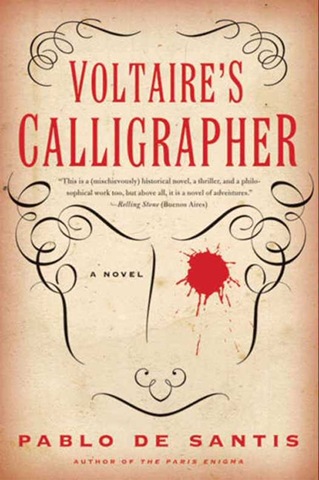
Voltaire's Calligrapher, Pablo de Santis
Dalessius is twenty when he comes to work for one of the Enlightenment’s most famous minds, the author and philosopher Voltaire. As the great man’s calligrapher, Dalessius becomes witness to many wonders—and finds himself in the middle of a secret battle between the malevolent remnants of the all-but-dead Dark Ages and the progressive elements of the modern age. The calligrapher’s role in this shadowy conflict will carry him to many perilous places— through the gates of sinister castles and to the doors of a bizarre bordello; toward life-and death confrontations with inventive henchmen, ingenious mechanical execution devices, poisonous fish, and murderous automatons. As the conspiracy to halt the Enlightenment’s astonishing progress intensifies, young Dalessius’s courage—as well as Voltaire’s unique cunning and wit—are put to the ultimate test as they strive to ensure the survival of the future.
This one's surprising as this one didn't really register at first glance. Now it's got my full attention.


The Grift, Debra Ginsberg
What happens when a pseudo psychic suddenly gets the real gift?

Marina Marks has been on the grift as a psychic since she was a child, forced into the business by a junkie mother who was always desperate for her next fix—and willing to use her solemn dark-haired daughter to peddle an extra buck. As an adult, Marina has earned a handsome living preying on the dreams and fears of her clients. She doesn’t believe there is such a thing as psychic ability, but she does believe in intuition. Her gift is the ability to gain the trust of her clients and subtly raise her fees as they become more attached to her and her readings.

But when Marina moves her “intuitive counseling” business out of muggy, cloying Florida to the milder environs of southern California, her past follows her. As she takes on new clients—a trophy wife desperate to bear a child, a gay man involved with a closeted psychiatrist, and a philandering businessman who’s smitten with her—a former client resurfaces in an eerie way. Suddenly, Marina is in love for the first time, but it is a romance whose roots lie deep in her past and threaten her efforts to reinvent herself.

As Marina’s life gets more and more entangled with those of her clients, she makes a startling discovery: she suddenly has the actual ability to see the future. After predicting a murder exactly as it happens, she becomes the sole suspect. Now she’s the desperate one—desperate to clear her name and to discover the meaning behind her visions.
Funny about this book, it's now available at a lot of bargain book shops around the metro. Though I'm not really partial to con stories, the cover's striking enough for me to check it out.
When Dr. Leo Liebenstein’s wife disappears, she leaves behind a single, confounding clue: a woman who looks, talks, and behaves exactly like her—or almost exactly like her—and even audaciously claims to be her. While everyone else is fooled by this imposter, Leo knows better than to trust his senses in matters of the heart. Certain that the original Rema is alive and in hiding, Leo embarks on a quixotic journey to reclaim his lost love.

With the help of his psychiatric patient Harvey—who believes himself to be a secret agent who can control the weather—Leo attempts to unravel the mystery of the spousal switch. His investigation leads him to the enigmatic guidance of the meteorologist Dr. Tzvi Gal-Chen, the secret workings of the Royal Academy of Meteorology in their cosmic conflict with the 49 Quantum Fathers, and the unwelcome conviction that somehow he—or maybe his wife, or maybe even Harvey—lies at the center of all these unfathomables. From the streets of New York to the southernmost reaches of Patagonia, Leo’s erratic quest becomes a test of how far he is willing to take his struggle against the seemingly uncontestable truth he knows in his heart to be false.

Atmospheric Disturbances is at once a moving love story, a dark comedy, a psychological thriller, and a deeply disturbing portrait of a fracturing mind. With tremendous compassion and dazzling literary sophistication, Rivka Galchen investigates the moment of crisis when you suddenly realize that the reality you insist upon is no longer one you can accept, and the person you love has become merely the person you live with. This highly inventive debut explores the mysterious nature of human relationships, and how we spend our lives trying to weather the storms of our own making.
This one looks complicated enough, which is what I love in books like these.