Showing posts with label comics. Show all posts

Sunday, April 18, 2010

Komikon Virgin


Well, I do admit it was my first time: I was attending the 6th iBlog Summit at the University of the Philippines on Saturday and I thought of passing by to check out the Komikon at the nearby U.P. Bahay ng Alumni.

Serendipity aside, I sometimes had a chance of passing by previous incarnations of Komikon but never got around to doing it. But this time, my office colleagues and I had lunch at Chocolate Kiss on the 2nd floor of the building and I thought I might as well drop by.

And what a sight there was to see there, with indie and self-published 'zines and comics on display on creators' tables all over the place. There was Bayan Knights, Gerry Alanguilan's Elmer (which I finally bought a copy on convention discount), Budgette Tan's Trese, Manix Abrera's 12 (with ads proclaiming his next kikomachine output), Laban: A Love Story, Kubori Kikiam, Philippine Adventure & Romance Stories,...

There were also anime series on DVD being sold, as well as cosplay clothes, collectible toys, graphic novels and-- of course-- lots of mainstream comics from DC, Marvel, etc. The PinoyWriMo were also there, hand-selling their e-novels to passersby.

What was interesting for me was the can-do spirit of the comic book creators at the event, of how they've managed to put in their love for the form and the storytelling medium to come upw these works using their own time, money and effort.

The other interesting thing that happened to me at the event was that, while dining at Chocolate Kiss, Gerry Alanguilan sat down at the next table and I went fanboy on him to get my copy of Elmer signed, which he gamely did.

Would I wish more creators were like this, eh?

Saturday, August 15, 2009

Notes from the Trenches

1. Some interesting discussions happening over the National Artist controversy (i.e. the selection of filmmaker Carlo J. Caparas, et al.).

2. On one hand is noted illustrator Gerry Alanguilan's vociferous objections against CJC's selection all collected here.

3. On the other hand, some discussion over here has led to some interesting observations with the original poster Deus Arquera and local firebrand Adam David actually taking the position that CJC is eligible to be selected as National Artist for Visual Arts (i.e. komiks or comics).

a) though Adam does convey his opinion against the whole show here (which Deus also affirms in the said post).

4. I tried to integrate the two discussions together by raising it in the comments, i.e:
a) Gerry Alanguilan raised some pertinent elements on the difference between art forms especially with regard to comics... I see your point in raising comparisons with architecture, film, etc. However, I also see Gerry’s point. My question is: are apples and oranges the same? (That is, should the comparisons apply given that these are different forms of art?)

b) We know the contributions of all artists have equal merit. However, in the aforementioned discussion in Gerry Alanguilan’s blog, it was mentioned that though CJC came up with the idea of Panday, it was the illustrator who came up with the look that’s etched into the masses’ mind. And how about the role of FPJ as the movie-version of Panday? Does that count?

I guess my question is: does the sole merit of an artwork lie in the one who conceptualized/created the idea or the one who translates it? And what happens when the translation becomes more popular than the creation?

5. Deus' answers my first question with:
a) Gerry Alanguilan’s argument is that the executors, like (National Artist for Scupture Arturo) Luz’s carpenters, have no room for interpretation, which I disagree with. The executors aren’t machines, so how can there not be some degree of interpretation? There is no such thing as absolute, total control over the creative process.
6. While Adam states (in vernacular, translated to English):
a) What I contest about Sir Gerry's call is the exclusivist compartamentalist view of creation. It seems like you're saying the contribution of merit in the growth of a tree is the water and not the sun or soil or care. Deus' point and my point as well is that not only the water or sun or soil or care makes the tree grow: all of this contributes in its growth regardless if it's an apple tree or an orange tree.
7. What do you people think? Who has merit of contribution in particular art forms?

8. Personally, I don't think I can subscribe to the viewpoint of the duo given that though Adam's observations may be correct, it still doesn't take into account the weight of the contribution. I mean, haven't we all heard of the oft-repeated saying "ideas are a dime a dozen" in writing? Isn't the effort, the execution rather than the conception that matters? And my flash fic "Black Worms" as a movie would be so much smoke if it weren't for Khavn's efforts.

9. From what I heard, CJC doesn't do much in terms of storyboarding. I'm not sure about preliminary sketches. So if we were to understand the problem, we have to ask: did CJC come up with the idea of his creations only or did he have other input?

10. For my second question, Deus answers:
a) That would be one of my questions as well, actually, which is why I am being ambivalent on the case of Caparas. It’s not as if we can readily quantify the contributions of the collaborators to a given creative project—assuming it is even possible. Hence, all this talk involving rigid, supposedly self-evident, supposedly logical, categories disturbs me, because these categories are not rigid, self-evident, or logical—they are arbitrary ones that a particular set of people has chosen to establish instead of others. “The Analytical Language of John Wilkins” by Borges is helpful in this regard.
11. Likewise, Adam sez:
a) That's what happened to Superman, didn't it? We all know Superman now doesn't rely on the pure concept of Siegel and Schuster, but on the overall whole mythology that's 70 years old, and what we know of Supermean now is not original to the intent of S&S (from flying to his kryptonite weakness). Once we apply this to our question, the purist argument collapses to Caparas' being qualified (for the award).

My answer there is that there is no single one who can take the entire (credit) on one thing especially if we're talking about a (collaborating) work, whether it's by intent (comics) or not (movie adaptation)...

... And the flaw of the apples and oranges analogy is that comics are a hybrid artform. It's an "applorange". And again, why should we compartmentalize things?
12. I would agree with Deus that this is an interesting question indeed, the tricky area of translations and renditions. One of my favorite books is a book by the Argentinean writer Angelica Gorodischer, Kalpa Imperial. It's wonderfully-written-- and it's translated into English by Ursula K. Le Guin. You have to wonder what would the creative sharing in translations: am I enjoying the prose because of Gorodischer or because Le Guin?

14. On the other hand, my perspective on Adam's point is that: I think it's a lot more complicated than that. For example, the superhero comicbook named Miracle Man was penned first by Alan Moore and then later by Neil Gaiman. However, before these writers came on-board, Miracle Man was originally a second-rate copy of Captain Marvel called 'Marvel Man'. Who remembers that first (original) version?

Tuesday, October 31, 2006

It's The End of the World...

... and I feel fine.

Of course that's what I get for getting into some interesting comic book reading material. Thanks to torrent, I've managed to catch up somewhat on some of the best comic book series out there. Yes, I know I'm a bit late in getting on the bandwagon but what can I say, I don't have the funds to get into both books AND comic books.

Serendipitously, the best two series I've read involved the end of the world:
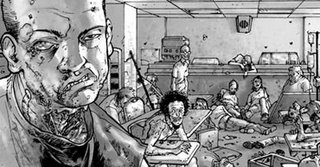

The first series is Robert Kirkman's The Walking Dead. In this series, a man wakes up in a coma (shades of 28 Days Later) and finds out that the world has gone to hell in a handbasket as zombies walk the earth, devouring the living and spreading like wildfire.

Now, you know my weird fixation on all things zombie. This series has all the trademarks of George Romero's zombie flicks: the undead, a naive protagonist who acts as our eyes as the events unfold, a group of characters thrown together by happenstance, lots of blood and gore, and a hell of a lot of cynical analyses of Civilization-As-It-Is-Overthrown.

It's the last part that separates this comic book from your usual horror stuff. As Kirkman says in an interview, good zombie movies are the ones that show how messed up we are. In this, Kirkman succeeds as he shows how people who are essentially good try to survive in a fucked-up world that's literally out to eat them. Sadly enough, he also shows that even with all the monsters out in the open, sometimes it's the monsters of the human heart that are the worse.

But that doesn't mean the series is all talk and drama. I remember one scene in the comic book which had me jumping up and down: two of the characters had to walk into a zombie-filled city to get guns and discover their disguise (which kept the zombies away) had been washed away by the rain. Really freaked me out.

As recommendations go, this comic book is perfect reading for tonight's Halloween.
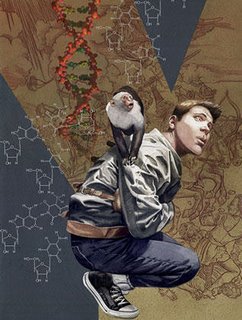

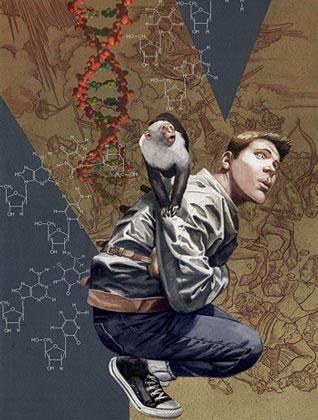
On the other hand, I am in awe of Brian Vaughn's Y The Last Man and I can see why this one is both critically acclaimed and quite popular as well. Despite sounding like a one-note affair, this series about Yorick Brown-- amateur escape artist and the titular last man on earth-- is fantastic as Vaughan delves into the deep-seated gender issues of a world wherein all males (both human and animals) have died off, leaving the female species behind.

For example, Vaughan is quite politically-astute, pointing out that among all the armed forces of the world, only Australia allows women to be part of their submarine forces (and thus giving them control of the seas). Moreover, he also subverts the male fantasy of such an idea (being the last man in a world full of women) by making Yorick a romantic, out to find his girlfriend and-- as much as possible-- trying to remain faithful to her. Take that, you perverts!

As one can see, characters is a strong point of this series, starting with his main protagonist: think of Yorick as a younger, geeky, wisecracking Crichton of Farscape fame. There's also 355, his female bodyguard-cum-secret agent who plays foil to Yorick's jester, and Dr. Mann (ironic, yes), a geneticist and expert in cloning, who's the straight man(woman) among the three. Combine all three and watch the snappy dialogue fly.

All in all, I liked this comic book better as compared to the previous one. In fact, if given enough funds, I'd probably collect the trades. I suppose it's because despite the grim ideas behind both series, hope and a sense of humour underlies the latter comic book.

And that, I think, is what we seriously need if ever the end of the world rolls around.