Thursday, June 29, 2006

Ex Libris: Much Ado About Dragons

I must admit that when it comes to book hype, I've succumbed several times-- but with good results.

I cite here Hal Duncan's Vellum and Susanna Clarke's Jonathan Strange and Mr Norrell, which I was overjoyed to find copies on our local shores upon learning about them on the Internet. So when Naomi Novik's His Majesty's Dragon came out with a lot of fanfare and hoopla (i.e. reports of a major advertising push by its publishers and general positive reviews), how could I not be giddy?

However, after all the hype, everything depends on whether I-- as a reader-- would like the book. Unfortunately, this is one time when I felt the hype didn't match the material.


In Novik's alternate-history, dragons are no myth but flesh-and-blood creatures. Given such strength in the dragon's clashing jaws, the powerful wings, and the slashing claws, it would come to no surprise that humans have managed to tame dragons to fight their wars. This is how Novik's story begins as the British and the rest of Europe try to survive during the Napoleonic wars.

Despite the availability of dragon power, Britain is still the captain of the seas-- to the advantage of young Capt. Will Laurence of HMS Reliant when they capture a French ship carrying a dragon's egg. Unfortunately, the egg hatches and before you could say "Smaug", Lawrence is catapulted from the British Navy to the fledgling Royal Air Force with the child-like black dragon which he names Temeraire. From there, it's a mad dash for training even as Lawrence deals with being uprooted from his whole life as well as trying to raise an impressionable yet smart young dragon.

But all doubts must end and in the story's climax, it's up to Lawrence, Temeraire and his companions to stop a massive French invasion of British shores.

So, what's not to like about Novik's book?

Well, on one hand: the story was well-paced and pretty exciting, the prose was above average (but not as florid as that other 19th-century book, Jonathan Strange and Mr Norrell) the characters were nicely-drawn out, and the setting was well-detailed including the practical uses of dragons. (How do dragons dogfight? Like World War II bombers combined with 19th century warships, complete with ground crew and boarding parties.) In fact, this was one of the best things about the book: Novik manages to hint broadly about the depth of the role of dragons throughout the world while filling in the details that would flesh out the reality of the story. This is one element writers of alternate-history books sometimes flub when introducing that differing factor in the story.

On the other hand: I guess the whole thing didn't work for me. It's a not unusual feeling for me to read a book that a lot of people loved but left me feeling cold (i.e. Harry Potter, Da Vinci Code) . However, this is one of the few times that it actually happened to a book that I wanted to like. It was frustrating: the feeling akin to slowly sliding from a slippery roof after recently cutting your nails.

I guess in the end, I would recommend this book to other people. But for me, I'd have to pass.

*sigh*

Tuesday, June 27, 2006

The Red, Red Robin Has Flown Away

Good grief.

Late as I am in getting around the blogoverse, I just found out that the lovely jenn see of the fish triumvirate has passed away. My condolences to her family and friends, especially to mysfit and oldben.

I don't remember when jenn first passed by this way electronically (so far off from the beaten track I think). However, the thing I do remember about her was how she described herself looking like WitchHunter Robin in her blog-- and then she showed a picture of herself with the same 'locks as the anime character. I had to laugh then.

(It's so surreal: how do you express your sympathies halfway across the world to people who you've only met thru the Internet-- for someone who you've only known thru her writings online? But still, there's a queer feeling of loss despite the fact that I barely knew her.)

Someone mentioned how ironic jenn's last paragraph of her last post was. Looking at it, I thought the same as much... but I also thought that's so very jenn of her:

so i will spend the next few days reveling in the past & in memories, collecting myself in the present, & looking to the future...which promises many new things & much Change, along with all that comes with these things.

Cheers, jenn. I'm glad I got to know you if only for a small time and only through this tiny window to the wide universe called the Internet.

Monday, June 26, 2006

Ex Libris: In Space, No One Can Hear You Scream


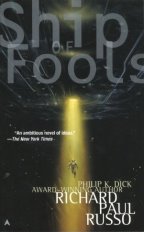
SF author Richard Paul Russo is a bit of a conundrum for me. I didn't like the first book I've read of his, Carlucci's Edge, because I thought it couldn't decide whether it was noir or cyberpunk, i.e. being too noirish to be cyberpunk and too cyberpunk to be noirish for its own good.

However, when I saw his next book, Ship of Fools-- about a generational ship encountering a mystery-- I just couldn't resist. After all, I'm always up for a little genre-sliding. The fact that it won a Philip K. Dick award in 2001 also counted in its favor.

We had not made landfall in more than fourteen years. One disastrous choice of a star after another. The captain viewed this string of failures as absurdly bad luck; the bishop, as divine intervention. Either way, I saw it as prelude to the captain’s downfall, which would almost certainly mean my own downfall as well.

With this opening line, Russo begins a tale involving a wandering generational starship looking for a planet to colonize. Unfortunately, after a number of failures, foment is brewing between the leaders-- alcoholic Captain Nikos Costas and power-hungry Bishop Soldano-- and their factions, as well as the much-abused undercaste crew of the ship. But at last the ship has found a possible planet-- except that like something out of the mystery of the Roanake colony, the colonizers discover the planet's previous inhabitants have all disappeared. And then they find out where the bodies are buried...

Soon enough, they encounter a signal in far-off space where they find a floating derelict bigger than their starship. Ecstatic at the first contact with a possible alien race, they try to tow the wreck back to civilized stars but soon find themselves grappling with an evil that would dwarf anything human minds can produce.

All in all, Russo has managed to spin an enthralling, spine-chilling story that combines science-fiction and horror effectively. In fact, this book reminded me of the movie Event Horizon and even the trailblazing Alien: the claustrophic narrative; characters acting like chittering rats in a dark, crowded hole; the overwhelming blackness of space; and a Lovecraftian evil that declares that yes, the Universe is inimical to humans.The fact that Russo's main protagonist, the deformed Bartolomeo, uses a noirish tone of voice adds another flavor of darkness to the story.

Like the movie Event Horizon, Russo's tale is excellent in idea and excellent in execution-- but unfortunately a bit lacking in climax. However, Russo has raised the bar so high such that when the reader comes to the last page, one can only forgive him for barely not reaching it (or not at all, depending on your mileage). Likewise, Russo raises a number of questions, including whether or not one has to believe in a god to believe in evil-- and whether 'evil' is just another name for 'alien'. In this, I think, Russo succeeded quite well.

For myself, the book shows that there is still Mystery and Evil outside the boundaries of our Earth-- and beyond the ken of men.

Friday, June 23, 2006

Fitting Square Pegs in Round Holes

Was mulling what bhex had written recently in her essay about local speculative fiction and how it was trapped in a 'middle ground':

we have the “highbrow” speculative fiction and graphical works rendered in English, and then we have the local “fantaseryes” in Filipino, which combine folklore based loosely on local and foreign traditions, with tried and tested soap opera formulas. The audience is trapped between these two extremes - and worse yet, they are trapped as an audience, unable to express the ideas sparked in them by the things they watch and read.

Moreover, she attributed the lack of science-fiction in our stories due to less than strong foundations in science education.

However, charles offered a different perspective:

I do think there is a reason for the scarcity in science-fiction, but it is not due to lack of education more than a lack of interest. Aside from the social-realism slant of our would-be literati, I think Filipinos have never shaken off the fantastical influence of our culture.

It's true that there is a dearth of local science-fiction stories in what is a booming field worldwide. For example, accounts of non-western science-fiction in China (an LJ-account that unfortunately seems to be out-dated) and India can tell us that SF seems to be alive and well in those countries. Hell, even checking out jp's blog will tell you a lot about the state of the genre in India. On the other hand, vin seemed to confirm the lack of SF locally when he lamented the fact that when he asked for stories for his recent dragon anthology, he noted there was almost no science-fiction subs. Fortunately, Dean's first volume of Philippine Speculative Fiction Anthology had at least one or two, if I remember correctly.

But as I've admitted before, I have a preference of stories involving the irrationality of the fantastical over the rigorousness of science and it seems to me that bhex and charles (partially anyway) seem to concentrate too much on science-fiction as opposed to its other siblings. I thought both of them had it right but I was wondering: speculative fiction is a triumvirate, isn't it? That is, science fiction as well as fantasy and horror. So what's wrong with having a fantastic Philippines?

In other words, granted that there's also a near-dearth of speculative fiction in local markets due to the almost-fanatical adherence of local literati to social realism, what's wrong with siding with fantastical stories over science-fiction? In fact, charles explained it best when he cited sociological factors like religion and pop culture as one of the swinging points for writers:

Seeing how the fantastical plays a big role in our culture combined with how we seem to take present technology for granted, a hybrid between fantasy and science-fiction seems more likely to occur rather than a pure science-fiction story.

Even Philippine literature's links to the fantastic cannot be denied as the eminent Cirilio Bautista explains about the magical realism in his review of Dean's novel:

Popularized by South American writers, (magical realism) fuses history with imaginings to configurate a situation that verges on the fantastic. The technique is almost made to order for the Filipinos who, like the South Americans, possess a consciousness which is a source spring of the unusual and the grotesque. Our geography and climate encourage extreme imagination. The influences of native religions, myths, legends, folktales, and epics have not been dimmed by the pressures of colonization and advent of modern technology. In fact, this consciousness gains energy by adjusting to western thoughts and gadgets. It accommodates imported realities without surrendering what it considers sacred and inviolable.

This is not to say that science-fiction should not be written by local scribes. However, as charles points out, science-fiction is more than about the science. Rather, science-fiction is also about the story: the characters involved, the sociological effects of a particular development, etc.

In other words, if we're to apply science-fiction to a local setting, I think we're setting ourselves up for a fall in trying to apply the theme of hard SF (i.e. the focus on natural or technological sciences in a particular story) in the Philippines. It would be better if local writers would think in terms of soft SF, i.e. the focus on human characters and their relations and feelings, while de-emphasizing the details of technological hardware and physical laws. Also important is the use of 'softer sciences' (like philosophy, psychology, political science, anthropology and sociology) in our stories.

Personally, I think writing science-fiction stories in the Philippines is akin to fitting square pegs in round holes. Though Metro Manila is so urbanized and cities are cropping throughout the whole archipelago, we-- even us born-and-bred city-slickers-- still have not taken the native-ness out of our blood such that we feel an almost-atavistic call in our souls when confronted by the rural wilds. And this comes out in our stories-- as Bautista calls it-- as "unusual and grotesque."

Furthermore, though writing science-fiction stories in the Philippines is not impossible, I do think-- speaking as a writer-- there is a thin line to cross before the story loses its local taste in favor of the SF touch.

Now on the matter of bhex's topic about the lack of market for local speculative fiction, that's a post for another day...

Thursday, June 22, 2006

You Set Yourself Up for That One, Buddy

I'm speechless (okay, not really).

Everyone knows I work for a news site. And though I'm not exactly the best online editor around (okay, not even second-best), at least I know when there's something wrong with a sentence.

So was I the only who found the follwing newsflash title at our rival Inq7 funny? That is, Filipina served at Queen Elizabeth’s 80th birthday lunch.

GUESS who was at the 80th birthday lunch of Queen Elizabeth II last week?
Apart from royalty and other dignitaries, a Filipina met with the British monarch for the second time. She is Lady Aurea Taguiang.
The native of Malasiqui, Pangasinan, Taguiang is the lead waitress at Mansion House, official residence of the Lord Mayor of the City of London. She served the Queen once before, when the British visited Mansion House in 1999, according to information from the British embassy in Manila.

Heh. I'm sure you thought the same thing I did.

In other news, guess who's coming out as a Penguin classic? Yep, it's Jose Rizal's book Noli me Tangere. Lovely-looking book. We're hitting the big leagues now. (From Ian)

P.S. And just in case anyone thinks I'm being biased, I saw this article today (Friday) in our website and had to do a double-take: Aliens involved in NPA operations?

The Armed Forces Northern Luzon Command (Nolcom) cited reports yesterday that foreign nationals were actively involved in New People’s Army (NPA) operations in Mt. Province and elsewhere in its area of jurisdiction.

Cannibalism and extra-terrrestials, oh my!

Wednesday, June 21, 2006

More Like A Smoothie Criminal, Really

I wasn't feeling well again so I decided to go home early last night. However, I couldn't resist passing by Booksale at the Edsa Central mall branch on Shaw boulevard to check out the latest in secondhand books.

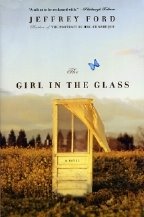
Imagine my surprise when I found this: Jeffrey Ford's Girl in the Glass!

Quite shameful. Absolutely criminal, actually. Though known more as a fantasist, Ford is reportedly one of "5 Mystery Writers Worth Investigating," to quote a Time magazine article. And though I haven't really read his novels (except for his first one), his short stories like "In Reparata", "The Weight of Words" and "A Night At the Tropics" have generally blown me away.

What did I do? Obviously, I bought the book.

I do admit that whenever I buy a secondhand book, I occasionally feel guilty. But given that this country doesn't get most of the good books and the books themselves are rather costly (including trying to order from abroad), I get by as best as I can.

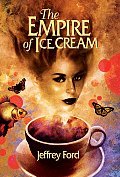
Which is why, to justify my purchase, I aim to order this from abroad as soon as possible:


*sigh* The things I do to appease my conscience. (Yeah right!)

Tuesday, June 20, 2006

Curious Cat Question

In a postscript to my earlier post about Dan Simmons and politics in writing, here's something another SF writer, Orson Scott Card, said in an interview about injecting his personal politics into his fiction:

My characters have political opinions, but they are rarely my political views... If I ever let my fiction be propaganda, then my career as a fiction writer is over.

Ironically, Card may be the best person to speak about this since his personal views against same-sex marriage (due to the fact that he's a Mormon) has drawn fire from the SFF community. However, his religious upbringing doesn't seem to impinge much on his writing though he does focus a lot on moral issues without turning it into heavy-handed preaching.

So my question is: Andrew mentioned that he doesn't like reading authors whose views may diverge from his. How about the rest of you people?

(Link from blog-meister John Scalzi)

P.S. And just in case some people missed it, I linked to an interesting essay by fantasist Jeff Vandermeer in my reply to Andrew's comments and so here it is: Politics in Fantasy.

Ex Libris: Of Fathers, Zombies and other Sentimental Things

(This was supposed to be a Father's Day special but am late as usual.)

Best-selling author Stephen King has always held a special place in this reader's heart, having been brought up on King's short stories like "The Mist" and the Bachman books thanks to my father. In fact, most of my short fiction has been informed by this upbringing with any speculative element in my stories being composed of horror first and fantastical second. Ironically, my father-- who's read all two of my published stories-- terms them as those "weird stories" which I find quite funny. Ah well.

Which brings me to my first point: fathers influence their children in ways they can't imagine.

Anyway, so when King's latest horror Cell work came out, I had the chance to buy the hardcover copy for him. Unfortunately, I have the bad habit of borrowing his books after he'd done with them and this was no exception.

In his latest work, King has not lost his touch as he goes back to an earlier effort reminiscent of The Stand, the end-of-the-world-as-we-know-it (also known as apocalyptic) fiction in a homage to George Romero's zombie flicks . In this case, King tackles an ubiquituous aspect of our life which is the cellular phone: everyone has one and everyone uses one.*

In what is described in King's trademark normal day, a series of Pulse through cell phones has managed to make their users into ravening zombie-like maniacs. For struggling illustrator Clayton Riddell, this is painfully ironic as he has just made his big break into the comic business (actually with Dark Horse comics). Now all Clayton can do is survive in order to find out if his wife and son managed to survive the violent onslaught.

Unfortunately, as Clayton learns, this isn't your regular zombie-disaster event. As the days go by, the survivors (or normies) find out the rules necessary for any apocalyptic scenario: traveling by night, leaving out shoes in front of the houses, etc. However, they find out the horror isn't over as they learn the zombies (or phoners) are evolving. As the pages go by, it soon becomes a race among the survivors to find out how the phoners are changing or else face extinction at the blood-stained hands of this new kind of human.

All in all, this is King back at his best with old-school horror after his turn with psychological horror (i.e. Gerald's Game and the rest) and his dark western fantasy (i.e. the Dark Tower). Likewise, since this is a zombie story with a twist, King tries to bring something new to the table ala Shaun of the Dead and 28 Days Later. With lots of gore and action and more intensely-paced, he succeeds quite admirably here as he manages to turn enough people into zombie-esque monsters on the day of the Pulse for a proper city-burning and flesh-chomping scenario (something I've always wondered how it happened in the remake of Dawn of the Dead.)

But it's not all action as King infuses his protagonists with a realness that makes you afraid for them as they face the gibbering hordes of monsters. (Whether or not this is great characterization of course is one of the arguments between pro- and anti-King proponents.) Unfortunately, Clayton becomes a bit of a cipher later on in the story and it is the secondary characters who take center stage, whether it's the frail teenager Alice who saw her mother garnish their taxi driver or the aging school headmaster Charles Ardai who has figured out the secret of the phoners. This is too bad as it's Clayton's love as a father that drives the characters from beginning 'til the end of the story. But this may be only nitpicking on my part and everything is all good about the book.

I suppose you could accuse me of thinking that King can do no wrong; however, I'll be the first to admit that I've actually wasn't able to finish a handful of his books, including the Dark Tower sequence. On the other hand, I'm feeling particularly fanboy-ish as this is the first time I've seen King tip his hat to his fellow writers in the speculative fiction trench, citing science fiction writers like William Gibson and Bruce Sterling.

Which brings me to my second point: for someone like myself who has a childhood fear of zombies, having King writing a zombie-esque story is like having your father tell you that particularly scary story at bedtime. But since your father is there, you know everything will be alright and that you'll be able to sleep at night. And true enough, I didn't have any bad dreams about this book.

*Of course King mustn't have heard of the Philippines, whose people have a tendency to text more rather than call. Yes, even in an emergency. After all, we're the text capital of the world. But I digress...