Showing posts with label bookstores. Show all posts

Tuesday, July 05, 2011

All the books of the world (a retro book post)

I remember an earlier comment by JP about how our book tastes have diverged since we've known each other since the Cretaceous Period (in internet time), from genre books to more far-ranging titles.

Admittedly, my reading tastes still go with speculative fiction and specifically with the trio of fantasy, horror and science fiction. However, looking at the past book purchases, I thought that this isn't totally true given a number of books I've picked up here and there.

For example, see what I've gotten for the month of March:
  1. The Dictionary of Imaginary Places (expanded) - Alberto Manguel and Gianni Guadalupi, editors
  2. The Crippled God - Steven Erikson
  3. Sideways in Crime - Lou Anders, editor
  4. The Fallen Blade - Jon Courtenay Grimwood
  5. Generation Loss - Elizabeth Hand
  6. The Insult - Rupert Thomson
  7. Voices of Time - Eduardo Galeano
  8. 54 - Wu Ming
  9. Cracking Mountain and other stories - Osamu Dazai
  10. Dr Mukti and other tales of woe - Will Self
  11. Pattern Recognition - William Gibson
If you noticed, there's a handful of books here that wouldn't be regarded as genre, like Rupert Thomson and Will Self. What's more, what I like about the books I picked up for that month was that they weren't just from the usual US/UK writers with Eduardo Galeano from Argentina and Osamu Dazai from Japan. (Wu Ming is actually a group pseudonym, being the same group of writers who wrote under the name of Luther Blissett and came up with the novel Q.)


Of course my prize purchase for that month was Manguel and Guadalupi's grand-looking Dictionary of Imaginary Places, a catalog of fantasy places whether literary or genre. Perusing through the book, I'm amazed at how the editors have also managed to include locations from forgotten and obscure stories.

For the month of April, I tried to run up a book blockade again, feeling that I had too many. (It happens. *shrug*) Unfortunately I failed when I saw a copy of Simon Ings' Weight of Numbers, which Chiles had heavily recommended to me and especially after I read Ings' contribution to the VanderMeers' The New Weird anthology. The other books I bought for that month were a hardbound copy of Tad Williams' The Dragonbone Chair (which I've always wanted to match the rest of the trilogy I owned) as well as the anthology Dark Matter: A Century of Speculative Fiction from the African Diaspora edited by Sheree Thomas.


For the month of May, my reluctance to add to the ever-growing pile of books at home was still present. But like the previous month, I couldn't resist picking up hardbound copies of Carlos Luis Zafon's The Angel's Game and Daniel Abraham's The Price of Spring, as well as Mike Resnick's the Pyr trade paperback The Buntline Special. I fell in love with Zafon's Shadow of the Wind when I first read it but I held off buying the sequel because I was looking for that perfect cover match. (No, it's still not a match but the cover's lovely. Really, sometimes you just have to get that second copy to make everything match on your bookshelves.)


Lastly, for the month of June, I kind of splurged again with a mix of genre and literary books. These included:
  1. Books of Blood - Clive Barker
  2. Fantastic Worlds: Myths, Tales and Stories - Eric Rabkin
  3. Our Tragic Universe - Scarlett Thomas
  4. The Girl with the Glass Feet - Ali Shaw
  5. Under Heaven - Guy Gavriel Kay
  6. Philippine Speculative Fiction volume 6 - Nikki Alfar, Kate Osias
  7. The Spirit Stone - Katharine Kerr
  8. God's Demon - Wayne Barlow
I used to have a copy of Barker's seminal Books of Blood but I gave it away as a gift. The Rabkin is described as more of an academic collection than a real anthology so I'm interested to see what the crits/essays in it have to say. With regard to the books by Scarlett Thomas and Ali Shaw, I've been waiting for these titles (together with a long list of similar books) for a long time so I immediately snapped these up with my new credit card. (Yes, I finally got one. No, I can't use it anymore. What do you expect, give a bookhound a credit card and he'll max it at a bookstore.)

So, that's where my money's been going for the past four months. At least even if I go hungry, I definitely won't be bored.

Friday, March 04, 2011

Books around the world

Once again, we're back with the latest list of interesting books I've found on the shelves. And what a fascinating bunch I've found.


Nikolski, Nicolas Dickner:
Intricately plotted and shimmering with originality, Nikolski charts the curious and unexpected courses of personal migration, and shows how they just might eventually lead us to home.

In the spring of 1989, three young people, born thousands of miles apart, each cut themselves adrift from their birthplaces and set out to discover what - or who - might anchor them in their lives. They each leave almost everything behind, carrying with them only a few artefacts of their lives so far - possessions that have proven so formative that they can't imagine surviving without them - but also the accumulated memories of their own lives and family histories.

Noah, who was taught to read using road maps during a life of nomadic travels with his mother - their home being a 1966 Bonneville station wagon with a silver trailer - decides to leave the prairies for university in Montreal. But putting down roots there turns out to be a more transitory experience than he expected. Joyce, stifled by life in a remote village on Quebec's Lower North Shore, and her overbearing relatives, hitches a ride into Montreal, spurred on by a news story about a modern-day cyber-pirate and the spirit of her own buccaneer ancestors. While her daily existence remains surprisingly routine - working at a fish shop in Jean-Talon market, dumpster-diving at night for necessities - it's her Internet piracy career that takes off. And then there's the unnamed narrator, who we first meet clearing out his deceased mother's house on Montreal's South Shore, and who decides to move into the city to start a new life. There he finds his true home among books, content to spend his days working in a used bookstore and journeying though the many worlds books open up for him.

Over the course of the next ten years, Noah, Joyce and the unnamed bookseller will sometimes cross paths, and sometimes narrowly miss each other, as they all pass through one vibrant neighbourhood on Montreal's Plateau. Their journeys seem remarkably unformed, more often guided by the prevailing winds than personal will, yet their stories weave in and out of other wondrous tales - stories about such things as fearsome female pirates, urban archaeologists, unexpected floods, fish of all kinds, a mysterious book without a cover and a dysfunctional compass whose needle obstinately points to the remote Aleutian village of Nikolski. And it is in the magical accumulation of those details around the edges of their lives that we begin to know these individuals as part of a greater whole, and ultimately realize that anchors aren’t at all permanent, really; rather, they're made to be hoisted up and held in reserve until their strength is needed again.
The teenage angst thing here is a bit off-putting but it has pirates so it must be a good thing.


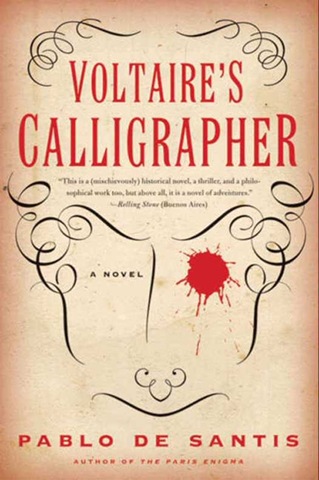
Voltaire's Calligrapher, Pablo de Santis
Dalessius is twenty when he comes to work for one of the Enlightenment’s most famous minds, the author and philosopher Voltaire. As the great man’s calligrapher, Dalessius becomes witness to many wonders—and finds himself in the middle of a secret battle between the malevolent remnants of the all-but-dead Dark Ages and the progressive elements of the modern age. The calligrapher’s role in this shadowy conflict will carry him to many perilous places— through the gates of sinister castles and to the doors of a bizarre bordello; toward life-and death confrontations with inventive henchmen, ingenious mechanical execution devices, poisonous fish, and murderous automatons. As the conspiracy to halt the Enlightenment’s astonishing progress intensifies, young Dalessius’s courage—as well as Voltaire’s unique cunning and wit—are put to the ultimate test as they strive to ensure the survival of the future.
This one's surprising as this one didn't really register at first glance. Now it's got my full attention.


The Grift, Debra Ginsberg
What happens when a pseudo psychic suddenly gets the real gift?

Marina Marks has been on the grift as a psychic since she was a child, forced into the business by a junkie mother who was always desperate for her next fix—and willing to use her solemn dark-haired daughter to peddle an extra buck. As an adult, Marina has earned a handsome living preying on the dreams and fears of her clients. She doesn’t believe there is such a thing as psychic ability, but she does believe in intuition. Her gift is the ability to gain the trust of her clients and subtly raise her fees as they become more attached to her and her readings.

But when Marina moves her “intuitive counseling” business out of muggy, cloying Florida to the milder environs of southern California, her past follows her. As she takes on new clients—a trophy wife desperate to bear a child, a gay man involved with a closeted psychiatrist, and a philandering businessman who’s smitten with her—a former client resurfaces in an eerie way. Suddenly, Marina is in love for the first time, but it is a romance whose roots lie deep in her past and threaten her efforts to reinvent herself.

As Marina’s life gets more and more entangled with those of her clients, she makes a startling discovery: she suddenly has the actual ability to see the future. After predicting a murder exactly as it happens, she becomes the sole suspect. Now she’s the desperate one—desperate to clear her name and to discover the meaning behind her visions.
Funny about this book, it's now available at a lot of bargain book shops around the metro. Though I'm not really partial to con stories, the cover's striking enough for me to check it out.
When Dr. Leo Liebenstein’s wife disappears, she leaves behind a single, confounding clue: a woman who looks, talks, and behaves exactly like her—or almost exactly like her—and even audaciously claims to be her. While everyone else is fooled by this imposter, Leo knows better than to trust his senses in matters of the heart. Certain that the original Rema is alive and in hiding, Leo embarks on a quixotic journey to reclaim his lost love.

With the help of his psychiatric patient Harvey—who believes himself to be a secret agent who can control the weather—Leo attempts to unravel the mystery of the spousal switch. His investigation leads him to the enigmatic guidance of the meteorologist Dr. Tzvi Gal-Chen, the secret workings of the Royal Academy of Meteorology in their cosmic conflict with the 49 Quantum Fathers, and the unwelcome conviction that somehow he—or maybe his wife, or maybe even Harvey—lies at the center of all these unfathomables. From the streets of New York to the southernmost reaches of Patagonia, Leo’s erratic quest becomes a test of how far he is willing to take his struggle against the seemingly uncontestable truth he knows in his heart to be false.

Atmospheric Disturbances is at once a moving love story, a dark comedy, a psychological thriller, and a deeply disturbing portrait of a fracturing mind. With tremendous compassion and dazzling literary sophistication, Rivka Galchen investigates the moment of crisis when you suddenly realize that the reality you insist upon is no longer one you can accept, and the person you love has become merely the person you live with. This highly inventive debut explores the mysterious nature of human relationships, and how we spend our lives trying to weather the storms of our own making.
This one looks complicated enough, which is what I love in books like these.

Sunday, February 27, 2011

February Books


This month's gleamings are a bit bare, appropriate enough as I seriously thought my book-buying had dried up for this month. Fortunately, the last two books came just under the wire and I thought they were certainly worth it.

1. Corvus, Paul Kearney (a sequel to his action-packed The Ten Thousand)
2. Hardcore, Andy Remic (I needed a little military SF hit)
3. The Genizah at the House of Shepher, Tamara Yellin
4. The Face in the Frost, John Bellairs
5. The Wandering Unicorn, Manuel Mujica Lainez (a complete unknown but has a Borges foreword, which is nice if you can get him, right?)

A couple of brand-new books in there with the rest second-hand. Still waiting for certain books to arrive in bookstores, alas.

January Books


I didn't have the time to post last month's bookhaul so here they are in all their bound glory.

Two points of interest:

(a) Yes, I am pushing through with my John Le Carre phase.

(b) Interesting enough, of the ten books I have here, only two are brand-new, which is the price of having a too-small salary.

1. Drood, Dan Simmon
2. The Gone-away World, Nick Harkaway
3. Gears of the City, Felix Gilman (a lucky find, the sequel to his The Thunderer)
4. A Most Wanted Man, John Le Carre (with this copy, am wondering if I should collect HB)
5. The Man on the Ceiling, Steve Rasnic Tem and Melanie Tem
6. Battle Royale,Koushun Takami (finally decided to try to the book instead of the manga)
7. The Wooden Sea, Jonathan Carroll (time to give Carroll another chance)
8. The Spider's Kiss, Debbie Gallagher (prose looks blah but will give it a shot)
9. Snow, Orham Pamuk (finding a 2nd-hand Pamuk is always a good thing)
10. A Darkness Forged in Fire, Chris Evans
11. The Mission Song, John Le Carre

On to the next month!

Thursday, January 20, 2011

Books around the world

Once again, I've trawled the bookshelves for some interesting books that caught my attention and may catch yours. And as the post says (and seen from my previous posts here, here, here and here), some of these books come from all over the world, providing us with some information what books the world is reading (and writing).

Admittedly, most of the books in this batch seem to be localized either in UK or in the US. But what the heck, you can't always get what you want.

Thus, without further distraction, I present the first books that hopefully gets you reading (and buying) for the year 2011:

The First Stone by Elliot Hall
Private eye Felix Strange doesn't work homicide cases. He saw enough dead bodies fighting in Iran, a war that left him with a crippling disease that has no name and no cure. So when Strange is summoned to a Manhattan hotel room to investigate the dead body of America's most-loved preacher, he'd rather not get involved.

Strange has a week to find the killer, and even less time to get the black-market medicine he needs to stay alive. In an America where biblical prophecy is foreign policy, Strange knows that his hiring is no accident. He can't see all the angles, and he knows he's being watched. In a race against time Strange must face religious police, organized crime and a dame with very particular ideas, while uncovering a conspiracy that reaches the very heart of his newly fundamentalist nation.

One of the most stunningly original debut crime novels ever written, The First Stone is both an epic of the imagination and an action-packed mystery set in a time and place too chillingly close to our own. It is the first in an ambitious trilogy that pays homage to the genius of Dashiell Hammett, Raymond Chandler and James Ellroy, while offering a wholly original take on the noir genre.
The Broken World by Tim Etchell
Writing an online ‘walk-through’ to a computer game of Borgesian complexity can take up a lot of time. So much so, it can be difficult to see things turning sour in the real world. As our narrator grapples with his players’ guide, life starts to intrude in troublesome ways. Things aren’t going so well with the live-in girlfriend and the job preparing ‘cooked circular food’ is getting increasingly hard to stomach. To top it all, the best friend is clearly depressed and acting weirder by the day. But despite all this, his attention is focussed on The Broken World – an engrossing, possibly addictive, adventure that takes him from town to town in a struggle with zombies, agents, puzzles and mysteries. It’s not clear which of these worlds - the real or the online - is the more challenging, or where survival tips are more urgently needed. What is clear is that he must work out solutions to problems involving life and love and happiness, not just in The Broken World, but in the real one too.
The Stranger by Max Frei
The millions-selling fantasy epic of the new Russian literary icon-a freeloading freebooter who finds a new home in a magical world

Max Frei's novels have been a literary sensation in Russia since their debut in 1996, and have swept the fantasy world over. Presented here in English for the first time, The Stranger will strike a chord with readers of all stripes. Part fantasy, part horror, part philosophy, part dark comedy, the writing is united by a sharp wit and a web of clues that will open up the imagination of every reader.

Max Frei was a twenty-something loser-a big sleeper (that is, during the day; at night he can't sleep a wink), a hardened smoker, and an uncomplicated glutton and loafer. But then he got lucky. He contacts a parallel world in his dreams, where magic is a daily practice. Once a social outcast, he's now known in his new world as the "unequalled Sir Max." He's a member of the Department of Absolute Order, formed by a species of enchanted secret agents; his job is to solve cases more extravagant and unreal than one could imagine-a journey that will take Max down the winding paths of this strange and unhinged universe.
The Serialist by David Gordon
Harry Bloch is a struggling writer who pumps out pulpy serial novels—from vampire books to detective stories—under various pseudonyms. But his life begins to imitate his fiction when he agrees to ghostwrite the memoir of Darian Clay, New York City’s infamous Photo Killer. Soon, three young women turn up dead, each one murdered in the Photo Killer’s gruesome signature style, and Harry must play detective in a real-life murder plot as he struggles to avoid becoming the killer’s next victim.

Witty, irreverent, and original, The Serialist is a love letter to books—from poetry to pornography—and proof that truth really can be stranger than fiction.
So, tell me, any of these books whet your appetite?

Friday, December 31, 2010

December Books

Well, like I said, December turned out a splurge of books as I took advantage of gift certificates and some extra cash to go on a buying spree. And what a load of books, around 26 books for this month. You can see why my to-read pile keeps getting bigger and bigger despite my efforts.


For this pile, you can see the late Kage Baker's The Empress of Mars, Ian C. Esslemont's The Return of the Crimson Guard, Ian McDonald's The Dervish House, Hannu Rajaniemi's The Quantum Thief, Rachel Pollack's hard-to-find Unquenchable Fire, Susan R. Matthews' Warring States, M.J. Enge's Wheel of the Winds, the new fairy tale anthology My Mother She Killed Me, My Father He Ate Me, Peter Crowther's collection Lonesome Roads, Roberto Bolano's 2666, Eric Brown and H.G. Well's The War of the Worlds, and Blood and Guts and Zombies, Otsuichi's collection Zoo, Iain Sinclair's Slow Chocolate Autopsy (with David McKean) and China Mieville's Kraken.


For this grouping, you can see Mira Grant's Feed, M.K. Hobson's Native Star, Amanda Downum's The Drowning City, Tim Lebbon's Echo City, Aidan Tchaikovsky's Blood of the Mantis, Paul Park's The Tourmaline, James Lovegrove's The Age of Odin and Ari Marmell's Conqueror's Shadow.

At the side of the pile are my two non-fiction books: The Book of Divining the Future and The Dictionary of Superstitions. Weirdly enough, despite the fact that I can probably google the information in these books easily, I like the idea of having this information on hand (or in hand). Goes to show that between a book and Google, I'll still go with a book. Especially a cheap one.

Just a thought: the number of books for this month equals the number of books I've read for the year. So in a sense, I just replenished this year's reading list in just one month. Go figure.

Thursday, December 02, 2010

November Books

Only a small load of books for this month, which is not surprising given that I usually splurge at the end of November. At the very least I managed to pick up the latest output in the Wheel of Time series, Towers of Midnight by the late Robert Jordan and currently written by Brandon Sanderson. Suffice to say, I immediately dug into the book and managed to come out a few days later.

I also bought a couple of books, one at the months-long sale at A Different Bookstore in Serendra: 13 Bullets by David Wellington, who's creating a career out of reiterating classic monsters for today's age. I've already tried his first book on zombies and I definitely want to see what he did with vampires.

Lastly, I picked up latest short story collection by one of my favorite writers in the world, Kelly Link. Pretty Monsters had actually been out here for quite some time but I had already read some of her stories in various collections and I didn't have the urge to get it earlier. Fortunately, I thought it was a good way to foreshadow my birthday with a Kelly Link book of stories, yes?

Now let's see what December brings in terms (and number) of books!

Sunday, November 28, 2010

Books Around the World

One thing I like about certain days-- like birthdays and Christmas-- is that I get to dream about going on a book-buying spree finally. At the very least, I can expect to get book gift certificates!

In this case, lists like these become my source for inspiration of what books to get (aside from the usual speculative fiction/genre books I can find on the shelves). For this iteration of Books Around the World, I managed to doggedly go through the shelves and bins of various bookstores for interesting selections.

To wit (watch your step, this is a long post):

From Israeli author Joshua Sobol, here is Cut Throat Dog:


An enigmatic Israeli who calls himself Shakespeare – because he’s got a way with words – finds himself jolted on a sidewalk in Manhattan: Is that who I think it is, he wonders, or am I crazy?

Who he thinks it is, is one of the world’s premier terrorists. Someone who murdered his partner. Someone he blames for the fog of despair that’s overcome him. And most shockingly, someone Shakespeare’s mysterious associates in Tel Aviv tell him had been killed in the desert.

So is Shakespeare cracking up, or cracking the case of a lifetime?

In the hands of esteemed Israeli author Joshua Sobol, the wicked riddle becomes a masterful work that transcends genre: It’s a sumptuously written literary novel and a taut spy thriller. It’s a moving recollection of a purposeful youth and a graphic account of the hunt for terrorists. It’s the story of a mid-life crisis and the endless crisis of the Middle East. It’s a work of wild and whimsical word-play and fast-paced, deadly gun-play.

It is, in short, the English-language debut of a mesmerizing writer at the top of his form.
From American-Lebanese writer Alia Yunis comes The Night Counter:


After 85 long years, Fatimah Abdullah is dying, and she knows when her time will come. In fact, it should come just nine days from tonight, the 992nd nightly visit of Scheherazade, the beautiful and immortal storyteller from the epic The Arabian Nights.

Just as Scheherazade spun magical stories for 1,001 nights to save her own life, Fatima has spent each night telling Scheherazade her life stories, all the while knowing that on the 1,001st night, her storytelling will end forever. But between tonight and night 1,001, Fatima has a few loose ends to tie up. She must find a wife for her openly gay grandson, teach Arabic (and birth control) to her 17-year-old great-granddaughter, make amends with her estranged husband, and decide which of her troublesome children should inherit her family's home in Lebanon--a house she herself has not seen in nearly 70 years. All this while under the surveillance of two bumbling FBI agents eager to uncover Al Qaeda in Los Angeles.

But Fatima’s children are wrapped up in their own chaotic lives and disinterested in their mother or their inheritances. As Fatima weaves the stories of her husband, children, and grandchildren, we meet a visionless psychic, a conflicted U.S. soldier, a gynecologist who has a daughter with a love of shoplifting and a tendency to get unexpectedly pregnant, a Harvard-educated alcoholic cab driver edging towards his fifth marriage, a lovelorn matchmaker, and a Texas homecoming queen. Taken in parts, Fatima’s relations are capricious and steadfast, affectionate and smothering, connected yet terribly alone. Taken all together, they present a striking and surprising tapestry of modern Arab American life.

Shifting between the U.S. and Lebanon over the last hundred years, Alia Yunis crafts a bewitching novel imbued with great humanity, imagination, and a touch of magic realism. Be prepared to be utterly charmed.
From Russian writer Ludmilla Petrushevskaya, there is There Once Lived a Woman Who Tried to Kill Her Neighbor's Baby: Scary Fairy Tales:


The literary event of Halloween: a book of otherworldly power from Russia's preeminent contemporary fiction writer

Vanishings and aparitions, nightmares and twists of fate, mysterious ailments and supernatural interventions haunt these stories by the Russian master Ludmilla Petrushevskaya, heir to the spellbinding tradition of Gogol and Poe. Blending the miraculous with the macabre, and leavened by a mischievous gallows humor, these bewitching tales are like nothing being written in Russia-or anywhere else in the world-today.
Another Israeli author, Assaf Gavron has penned Almost Dead:


Politically incorrect, provocative, and steeped in wit and irony, a fast-paced tragicomedy about the perfectly ordinary madness in today's Middle East

A thirtysomething Tel Aviv businessman, Eitan "Croc" Einoch's life is turned upside down when he narrowly escapes a suicide bombing on the minibus he rides to work. When he lives through a second attack, and then a third, he becomes, reluctantly, a national media celebrity. Naturally, the Palestinian terrorists responsible for the attacks are less than happy. This embarrassing symbol of their failure—this "CrocAttack"—must be neutralized.

Meanwhile, Fahmi Sabih lies in a coma, quarrelling with his conscience. The young Palestinian suicide bomber has learned everything he knows about bombs, targets, and revenge from his brother. So why has Einoch survived? As Fahmi's story unfolds, it becomes clear that their paths are destined to cross again—for there is another bombing still to come—and then luck will change drastically for one or both of them. But who, if anyone, has right on his side?
From British author Matt Haig, there is The Radleys:


Just about everyone knows a family like the Radleys. Many of us grew up next door to one. They are a modern family, averagely content, averagely dysfunctional, living in a staid and quiet suburban English town. Peter is an overworked doctor whose wife, Helen, has become increasingly remote and uncommunicative. Rowan, their teenage son, is being bullied at school, and their anemic daughter, Clara, has recently become a vegan. They are typical, that is, save for one devastating exception: Peter and Helen are vampires and have—for seventeen years—been abstaining by choice from a life of chasing blood in the hope that their children could live normal lives.

One night, Clara finds herself driven to commit a shocking—and disturbingly satisfying—act of violence, and her parents are forced to explain their history of shadows and lies. A police investigation is launched that uncovers a richness of vampire history heretofore unknown to the general public. And when the malevolent and alluring Uncle Will, a practicing vampire, arrives to throw the police off Clara’s trail, he winds up throwing the whole house into temptation and turmoil and unleashing a host of dark secrets that threaten the Radleys’ marriage.

The Radleys is a moving, thrilling, and radiant domestic novel that explores with daring the lengths a parent will go to protect a child, what it costs you to deny your identity, the undeniable appeal of sin, and the everlasting, iridescent bonds of family love. Read it and ask what we grow into when we grow up, and what we gain—and lose—when we deny our appetites.
Boy, I can't wait to go book-shopping next week.

Thursday, November 11, 2010

Books around the world

Riffing off my previous post about zombie movies, I've noticed that the current trend of zombie books has finally reached these shores with a handful of books on the bookshelves.

I suppose it's time for it, coming after Quirk Books' retroactive play of Pride and Prejudice and Zombies (by Jane Austen and Seth Grahame-Smith). After all, among the various monsters of pop culture, only the zombie genre (of the George Romero type) has been sorely underdeveloped.

Thankfully, these authors (with some I've heard about but not seen yet here) up to task. These range from:


Night of the Living Trekkies by Kevin David Anderson sounds like a fun romp fanfic about a Star Trek convention that gets invaded by zombies. The book cover doesn't look much but I managed to watch the book trailer (a terrific one at that) and got sold on it. Here's the blurb:
Journey to the Final Frontier of Sci-Fi Zombie Horror!

Jim Pike was the world's biggest Star Trek fan—until two tours of duty in Afghanistan destroyed his faith in the human race. Now he sleepwalks through life as the assistant manager of a small hotel in downtown Houston.

But when hundreds of Trekkies arrive in his lobby for a science-fiction convention, Jim finds himself surrounded by costumed Klingons, Vulcans, and Ferengi—plus a strange virus that transforms its carriers into savage, flesh-eating zombies!

As bloody corpses stumble to life and the planet teeters on the brink of total apocalypse, Jim must deliver a ragtag crew of fanboys and fangirls to safety. Dressed in homemade uniforms and armed with prop phasers, their prime directive is to survive. But how long can they last in the ultimate no-win scenario?
Granted, it doesn't look all that much but-- like I said-- the book trailer is the kicker!


Brains: A Zombie Memoir by Robin Beeker is an interesting look at what happens to a person who becomes a zombie. Think John Gardner's Grendel by way of George Romero's Night of the Living Dead. See the blurb:
College-professor-cum-zombie Jack Barnes is a different breed of undead—he can think. In fact, he can even write. And the story he has to tell is a truly disturbing—yet strangely heartwarming—one.

Convinced he'll bring about a peaceful coexistence between zombies and humans if he can demonstrate his unique condition to Howard Stein, the man responsible for the zombie virus, Barnes sets off on a grueling cross-country journey to meet his maker. Along the way he recruits a small army of "super" zombies that will stop at nothing to reach their goal. There's Guts, the dreadlocked boy who can run like the wind; Joan, the matronly nurse adept at reattaching decaying appendages; Annie, the young girl with a fierce quick-draw; and Ros, who can actually speak. United they embark on an epic quest to attain what all men, women—and, apparently, zombies—yearn for: equality.

On the other hand, Married with Zombies by Jesse Petersen sounds like a rom-com amidst a zombie outbreak... which is a weird premise, I grant you that. See the blurb:
A heartwarming tale of terror in the middle of the zombie apocalypse.

Meet Sarah and David.

Once upon a time they met and fell in love. But now they're on the verge of divorce and going to couples' counseling. On a routine trip to their counselor, they notice a few odd things - the lack of cars on the highway, the missing security guard, and the fact that their counselor, Dr. Kelly, is ripping out her previous client's throat.

Meet the Zombies.

Now, Sarah and David are fighting for survival in the middle of the zombie apocalypse. But, just because there are zombies, doesn't mean your other problems go away. If the zombies don't eat their brains, they might just kill each other.

On the other hand, Breathers: A Zombie's Lament by S.G. Browne sounds similar to Beek's book except that it deals with some interesting things like zombie rights. (Yes, now it sounds like a social satire in the vein of Fido. Yes, I know zombies are supposed to be social satire. Give over.) See the blurb:
Meet Andy Warner, a recently deceased everyman and newly minted zombie. Resented by his parents, abandoned by his friends, and reviled by a society that no longer considers him human, Andy is having a bit of trouble adjusting to his new existence. But all that changes when he goes to an Undead Anonymous meeting and finds kindred souls in Rita, an impossibly sexy recent suicide with a taste for the formaldehyde in cosmetic products, and Jerry, a twenty-one-year-old car-crash victim with an exposed brain and a penchant for Renaissance pornography. When the group meets a rogue zombie who teaches them the joys of human flesh, things start to get messy, and Andy embarks on a journey of self-discovery that will take him from his casket to the SPCA to a media-driven class-action lawsuit on behalf of the rights of zombies everywhere.
More or else all four books diverge from the usual survivors-versus-zombies story in the sense that you either have the perspective of zombies or you have some very varied cast of survivors. Is that different enough? I think it is.

(And just in case you've missed these, the YA section also has a couple of zombie books worth sinking your teeth in: Feed by Mira Grant and The Forest of Hands and Teeth by Carrie Ryan.)

What's more interesting is that there are a few more zombie books out there that are worth keeping an eye out. And these aren't your garden variety zombie apocalypses:

1. The Loving Dead by Amelia Beamer
2. One by Conrad Williams,
3. Pariah by Bob Fingerman
4. Handling the Undead by John Ajvide Lindquist
5. The Zombies of Lake Woebegotten, Harrison Geillor
6. The Reapers are Angels, Alden Bell

In particular, the Bell and Fingerman books look interesting because they promise a literary perspective on zombies. On the other hand, the Williams and Lindquist rate high in my list because I've read their previous works.

So... zombies much?

Friday, November 05, 2010

October Books


Finally, my book-buying drought had ended for October such that I've managed to get quite a pile for the past month. And quite a selection too, ranging from new books bought from Fully-Booked to the recent National Bookstore warehouse sale to Jasper's online bookshop Avalon.

The pile includes:
  1. Thomas Disch's The Sub
  2. Steven Hall's The Raw Shark Texts
  3. Avram Davidson's Adventure in Unhistory
  4. Lisa Goldstein's Dark Cities Underground
  5. Jonathan L. Howard, Johannes Cabal the Necromancer
  6. Escher on Escher: Exploring the Infinite
  7. N.K. Jemisin, The Hundred Thousand Kingdoms
  8. Mark Charan Newton, Nights of Villjamur
  9. John Le Carre, The Tailor of Panama
As you've noticed, the range here includes the usual genre fantasy, non-genre, horror, art non-fiction, and even spy thriller. Yes, we needs our books.

Sunday, October 24, 2010

Books around the world

(Coming back a second time is my post on books around the world. This is actually a cathartic experience for me because I usually don't get to buy whatever book I find interesting-- much more read it. As such, I'll just talk about it in posts like these. After all, that's what blogging is for, right?)

Wandering around Fully Booked is always an interesting experience for me because of the books I find on their bookshelves (which is more varied than Powerbooks). As such, I normally find books that aren't what you call run of the mill. Moreover, I like the fact that I seem to be getting a sample of works from all over the world.


For example, Drift by Sharon Carter Rodgers is published by a Christian publisher. But despite this, the book comes off as interesting with its noir-meets-apocalypse tone. Check out the back blurb on this one.
Charlie Murphy, boss of the crime syndicate, the Organization, is dead. His sassy, impulsive, bold, daring, and fearless twenty-year-old adopted-by-kidnapping daughter, Baby Doll, stands by his open grave—poised, ready to run. If Maurits, Charlie’s bodyguard and heir to the Justice position, discovers the role she played in Charlie’s death, she will pay the ultimate price.A few yards away, a freezing man huddles in a ball on a freshly filled-in grave. He doesn’t seem to be mourning. He seems to be helpless. Hopeless. Waiting. Foolish.He is a Drifter, waiting for a new tether—a person who will see him when no one else can. And he will stay with that person for an unknown period of time. For unknown reasons. He drifts through life invisible to all but one. Heaven and hell are unattainable for him. There is pain. Sometimes lots of pain. But there is no death, even when he wishes it would come. This time, he becomes tethered to Baby Doll, who is determined to finish what she started and will do anything to accomplish it.In a world where loyalties and betrayals are both rewarded with death, each pawn in this deadly game must stay one step ahead of the rest, or they will find themselves six feet under—next to Charlie Murphy.

Meanwhile, somewhere in the dark north, we have Finland's award-winning Troll by Johanna Sinisalo. I've actually heard this recommendation before and had a chance to get it at A Different Bookstore at the Podium (but didn't due to monetary reasons). I'm gld Fully Booked has stocks of this one now.
Everyone has their rough nights, but things have clearly taken a turn for the surreal when Angel, a young photographer, finds a group of drunken teenagers in the courtyard of his apartment building, taunting a young troll. Trolls are known in Scandinavian mythology as wild beasts like the werewolf, but this troll is just a small, wounded creature. Angel decides to offer it a safe haven for the night. In the morning Angel thinks he dreamed it all. But he finds the troll alive, well, and drinking from his toilet. What does one do with a troll in the city? Angel begins researching frantically. Angel searches the Internet, folklore, nature journals, and newspaper clippings, but his research doesn't tell him that trolls exude pheromones that have a profound aphrodisiac effect on all those around him. As Angel's life changes beyond recognition, it becomes clear that the troll is familiar with the man's most forbidden feelings, and that it may take him across lines he never thought he'd cross. A novel of sparkling originality, Troll is a wry, peculiar, and beguiling story of nature and man's relationship to wild things, and of the dark power of the wildness in ourselves.

Next up is a real find, a classic in every sense of the word: Edogawa Rampo's collection of short stories, Japanese Tales of Mystery and Imagination. This guy's real name is Hirai Taro but he became famous for this pseudonym (a Japanese play on the Edgar Allan Poe's name) and becoming the first modern writer of mysteries in Japan. Unfortunately, this slim book's a bit pricey even for me.


Lastly, Wonderful World by Javier Calvo has a great, eye-catching cover. Like some other selections I've picked, it's not really spec fic but this one reminds me of The Brief Life of Oscar Wao but more genre than literary. But it still looks interesting.
When Lucas Giraut inherits the family company from a father who never really cared enough to get to know him, it comes with a lot of unanswered questions...and an archenemy: Lucas's mother, Fanny. An ambitious and ruthless entrepreneur, Fanny believes her son is as useless as his father, whose recent, mysterious death delights her. Determined to understand exactly what he's been bequeathed, Lucas follows clues found in a windowless secret apartment—and in his dreams—deep in Barcelona's underworld and far from the comforts of his home, a former ducal palace. Meanwhile, Valentina Parini—a precocious and troubled seventh-grader and the self-proclaimed Top European Expert on the Work of Stephen King—looks to Lucas, her upstairs neighbor and only friend, as she struggles with growing up.
An interesting selection of books, yes?

Wednesday, September 15, 2010

Books around the world

There are lot of interesting stuff coming out in bookstores lately that aren't shelved in the science-fiction/fantasy shelves. For instance, a recent trip to Fully-Booked in Rockwell (before they closed for renovation) led me to discover a handful of books that I wished I could purchase if I had the money at that time.

What's more interesting is that a couple of these books were penned by non-Americans, which makes me enthusiastic again for buying books. At the top of the list is a Russian cyber-punk thriller written by Alexander Garros called Headcrusher. A national best-seller in Russia, it's now promised to be an international cult novel.


Here's the synopsis:
26-year-old Vadim hates his job in the PR department of Latvia's biggest bank. He spends his time playing his favourite shoot-em-up computer game, "Headcrusher," and composing insulting emails about his bosses. When his manager catches him writing one such email, Vadim is so overcome with rage that he kills him. Then he kills the bank's security guard too, because he has seen him disposing of the body. Bumping people off comes to seem as easy as playing a computer game (or moving money between bank accounts) and Vadim embarks on a killing spree, putting paid to anyone who annoys him. But, as he becomes embroiled in the murky activities of the corrupt bank, which is laundering money for Mafia criminals, he starts to lose touch with reality. Where does truth end and fantasy begin - and is life just one big computer game?

This high-octane debut novel has the energy of a Tarantino film, the game-playing of The Matrix and the philosophical quirkiness of Fight Club. Nothing quite like it has come out of Russia before. It has been a major bestseller there and has been picked up by publishers around the world.
For those who like their zombies, Alan Golsher does a number on the Beatles and throws in the requisite ninjas in Paul is Undead. However, what made this book stick in my memory is the fact that-- after perusing a few pages-- it actually has a section on the Beatles' visit in Manila. Oh joy!


Here's what you can expect:
Are readers ready for a world in which the Beatles just wanna eat your brains? Goldsherthinks so, and he may be right. In this humor-filled splatterfest, the rise and fall of the zombie Beatles unfolds through eyewitness accounts, newspaper clippings, and interviews. Violence and music go hand-in-hand as the zombiefied Lennon, Harrison, and McCartney fight, eat, and rock their way to fame and popularity while ninja lord Ringo Starr tries to keep them out of trouble. Nothing can stop them--not even a vampiric Pete Best, zombie-killing Mick Jagger, rival ninja Yoko Ono, or bad reviews. In fact, their only enemies may be one another, as personal conflicts threaten to break them up for good. Roughly paralleling the real-world career of the Beatles, this alternate history reimagines successes, failures, and rivalries with over-the-top bizarro charm.
A third book I've already seen as paperback in shelves, thus increasing its chance that I'll pick this one up. The very strange The Gone-Away World by Nick Harkaway has already received its fair share of mixed reviews. However, at paperback prices, I'm so there anyway.


Check it out:
This unclassifiable debut from the son of legendary thriller author John le Carré is simultaneously a cautionary tale about the absurdity of war; a sardonic science fiction romp through Armageddon; a conspiracy-fueled mystery replete with ninjas, mimes and cannibal dogs; and a horrifying glimpse of a Lovecraftian near-future. Go Away bombs have erased entire sections of reality from the face of the Earth. A nameless soldier and his heroic best friend witness firsthand the unimaginable aftermath outside the Livable Zone, finding that the world has unraveled and is home to an assortment of nightmarish mutations. With the fate of humankind in the balance, the pair become involved in an unlikely and potentially catastrophic love triangle. Readers who prefer linear, conventional plotlines may find Harkaway overly verbose and frustratingly tangential, but those intrigued by works that blur genre boundaries will find this wildly original hybrid a challenging and entertaining entry in the post-apocalyptic canon.
Lastly, I've found this one book by Russian writer Victor Pelevin, The Sacred Book of the Werewolf, quite interesting despite the fact that I still have an older book of his on my to-read pile (The Helmet of Horror). And though the reviews have also been mixed about this book, well, what the hell, right?


Summary here:
Russian novelist Pelevin's chaotic latest examines contemporary Russia as viewed through the eyes of A. Hu-li, a 2,000-year-old werefox who is able to transform into a beautiful nymphet. The opening chapter is both an introduction to werefoxes as well as an account of how werefoxes, working as prostitutes, utilize their stunning looks to absorb a man's life energy. Hu-li's experiences are standard for an ancient werefox until she meets Alexander, an attractive Russian intelligence officer who happens to be a werewolf. The two share a whirlwind romance, and after some trouble, shack up in Hu-li's bomb shelter. While hiding out, Hu-li and Alexander argue about religion, death, truth and the like until they both claim to be the super-werewolf. This argument—and Hu-li's disclosure of her true age—rupture the bliss. Pelevin creates interesting enough characters, but the unexplainable plot twists and the author's preoccupation with philosophical ramblings are nearly as perilous as a silver bullet.
There was a fifth book I found but I can't remember the title. The only thing I could remember was the fact that it was written by an Israeli author. Unfortunately, because Fully-Booked closed down for renovation, I can't go back to check. Curses, foiled!

Friday, July 02, 2010

June Books

Good grief, I bought only one book in the past month?

Will wonders never cease?

Though this is not exactly surprising given the haul I brought in the month prior. Likewise, I can proudly state that my Will-fu is strong in the face of selections on the bookshelves locally.

These include the lovely white hardbound Neil Gaiman's Stories or Cherie Priest's Boneshaker (which I had to forgo while in the US) or Hiroshi Yamamoto's The Stories of Ibis (which I've been slavering over even before I left for the US)...

Blame it on a developing sense of financial prudence in my burgeoning adulthood, dammit.

*sigh*

Tuesday, June 08, 2010

May Books


Sorry for the lack of updates for the previous week. After touching down from the US, I managed to catch my breath a bit before diving back into workload waiting for me. Unfortunately, I didn't really have a chance to to write (work or otherwise) while I was 'chilling' (damn cold in San Francisco!) at the Starbucks in Barnes & Noble.

So: first of all, here's a list of my bookhaul for the previous month which includes an order from bookwormbargain, a Multiply seller that had a very nice selection of classic fantasy books. From the latter I got:
  1. The Well At World's End Vol. 1 & 2, William Morris
  2. The Mezentian Gate and A Fish Dinner in Memison, E.R. Eddison
  3. Lord of Snow and Shadows, Sarah Ash (I sold my previous HB copy of this before.)
  4. The Story of the Stone, Barry Hughart (part of the Li Kao and Number Ten Ox series!)
Afterwards, I didn't really have much of chance (or a choice) to go around bookstores before I left for the US. Fortunately, I managed to remedy this once I got there. Here's a list of what I got there:
  1. Warriors, edited by George R.R. Martin and Gardner Dozois (Tor)
  2. Imaro, Charles Saunders (Nightshade Books)
  3. The Secret History of Science Fiction, edited by James Patrick Kelly and John Kessel (Tachyon)
  4. Bleak History, John Shirley (Pocket Books)
  5. A Walking Tour of the Shambles: Little Walks for Sightseers#16, Neil Gaiman and Gene Wolfe (American Fantasy)
  6. Temporary Agency, Rachel Pollack (Tusk Overlook)
  7. The Penguin Book of Modern Fantasy by Women, edited by A. Susan Williams and Richard Glyn Jones (Penguin)
  8. Doc Savage: His Apocalyptic Life, Philip Jose Farmer (Bantam)
  9. The Sons of Heaven, Kage Baker (Tor)
  10. The Age of Ra, James Lovegrove (Solaris)
  11. Sandman Slim, Richard Kadrey (Eos)
  12. Audrey's Door, Sarah Langan (Harper)
  13. Busted Flush, edited by George R.R. Martin (Tor)
  14. Flatland: A Romance of Many Dimensions, Edwin Abbott (Dover)
  15. The Secret History of Moscow, Ekaterina Sedia (Prime)
It may look like a large-ish haul-- well, yes it is-- and that I went on a shopping spree. But 2/3rd of the lot I sourced via secondhand bookshops (like Green Apple) or were discounted (like the Warriors HB from B&N) which helped greatly with my wallet.


In particular, I'm happy to have found copies of the Farmer and the Pollack books as well as the Penguin antho (I already found part one of that book). And no, there's still no such thing as having too many books.

Wednesday, May 26, 2010

Looking for the Right Books


(pic taken from here)

(Putting this up in advance as I'll be crossing the international dateline by today. See you on the other side!)


Admittedly, I didn't have enough time to check out the bookshops as much as I wanted for this trip because of priorities. This is sad because for the first time in my bibliophile career, I know the books that I want, where I can get them, and how much I want to pay for them.

In this case, my focus is on genre books like science fiction, fantasy and horror. I know that these books can be found at chain bookstores (like Borders and Barnes & Nobles) but I also know that my chances of finding the right books will be higher in smaller independent bookstores or those shops that specialize in these books.

Unfortunately, I missed out on a few indie bookshops in San Francisco for the simple fact that these stores close by 6 p.m. (Yes, we're spoiled in that Metro Manila is 'a city that never sleeps'.) These include Alexander Book Co. off Market street and Feldman's Books on El Camino Real.

Meanwhile, my fond memories of Stacey's Bookstore on Market Street is all that's left after I learned that it closed early last year. I also didn't have time to pass by Books Inc. (also on El Camino Real) when I saw it on the road. That's okay though as I was on my way to another great indie bookshop, Kepler's also in the area, where I picked up some new and 'gently-used' books.

(One good future strategy: I should check out university towns as these have a goodly number of indie bookstores. El Camino Real has Stanford while a number of bookshops are near Berkley.)

Other options I've managed to explore are the secondhand books in libraries, the Salvation Army and Goodwill shops-- really cheap and you might find some treasures there if you're patient enough. Alas, the selections are too haphazard in the Salvation Army and Goodwill and these places are too scattered to really make it a worthwhile venture.

As for libraries: gaah. I know libraries serve a good purpose in society but I really felt depressed at seeing the nicely-stocked science fiction and fantasy shelves of the Westborough Library. I had the strangest feeling that I should be running out of the library with those books in arms shouting, "Set these books free! They should be free!"

Anyway, it's all easy come, easy go. Still, I'll be glad to be back in Manila where one already knows all the favorite book haunts and what to expect there.

(NB: The blog where I took the above picture of Kepler's Books is incredible. The guy is doing an extensive book tour of small indie bookstores and all the places he's been to is incredible. I wish I knew about this blog before I went to the US.)